
By: Chris ⎜ Last updated





What are the parking rules in Norway? How do you read the parking signs, and how do you pay for parking? Read all you need to know about parking in Norway before your road trip.
Everything is app-based now
Norway has quietly gone almost entirely digital with parking. Coin meters are gone, many garages have no barriers or ticket machines at all, and enforcement is based on licence plate cameras.
Most street parking in Norwegian cities is paid through a phone app. Physical meters still exist in some places, but plenty of locations have removed them entirely. Some garages have no gates, no machines, nothing except a camera that reads your plate and a small sign explaining how you can pay for the parking.
The (almost) universal EasyPark app
EasyPark is the app that covers the most areas. It works across all Norwegian cities, at most private parking lots and garages, and in more than 20 countries across Europe. For a tourist with a rental car doing a week or two in Norway, it's the only parking app worth downloading.
Other apps
There are other apps, but you don't need to use them. Bil i Oslo covers Oslo municipal street parking, APCOA handles their own garages and most airports, and Parklink works at a growing number of private lots. All of them lets you skip the 15% service fee you'd pay through EasyPark. The savings are small for a one or two week trip, signing up for several extra apps, adding your credit card and license plate to all of them, in order to save a few kroner per session rarely makes sense. Just sign up for EasyPark.
Setting up your rental car in the app
Download EasyPark before you fly. Register with your email, add a credit or debit card (Visa, Mastercard or Apple Pay), and you're done. No Norwegian phone number is required.
The important step comes at the rental counter. The moment you have the car keys and know your licence plate number, open the app and add it. If you did not enter the correct licence plate number you will get a ticket even though you have paid. The inspectors scan plates against the EasyPark database, and if your plate isn't registered with an active session, you get fined even if you meant to pay.
EasyPark charges a 15% service fee on top of the parking rate, with a minimum of 4.90 NOK per session.
If you're parking daily for more than a few days, the EasyPark Go subscription eliminates the per-session fee for a flat 49 NOK per month.
How to read a Norwegian parking sign
The signs follow European conventions, but the sub-panels are in Norwegian. The pattern is at least consistent from Kristiansand to Tromsø. What follows below is only valid for municipal street parking, not private parking lots, such as Europark, Aimo Park etc where you will always have to pay.
The main signs are what you'd expect. A blue square with a white P means parking is allowed, subject to whatever conditions appear on the smaller white panel below it. A red circle with a single red diagonal line on a blue background means no parking. A red circle with a red X on blue background means no stopping at all, not even to drop off a passenger.
The sub-panel numbers are where the specifics go, and it's often quite confusing:
- Black text = weekday hours (Monday through Friday). So "08-17" means the restriction or fee applies from 08:00 to 17:00 on weekdays.
- Black numbers in parentheses = Saturday hours. "(08-15)" means 08:00 to 15:00 on Saturdays.
- Red text = Sunday and public holiday hours.
If there's no red text on the sign at all, that means Sundays and public holidays are completely free and unrestricted. Similarly, if you park outside the hours listed for your day of the week, parking is free until those hours start again. Time limits work the same way: a sign that says "Maks 2 timer" with hours "08-17" only enforces the two-hour limit during those hours. If you park at 16:00, you can pay for one hour and stay all night.
Some of these Norwegian phrases show up on almost every sign:
- "Mot avgift" = you need to pay during the listed hours
- "Maks 2 timer" = two-hour maximum parking duration during the listed hours
- "Unntatt med beboerkort Sone X" = conditions on the sign does not apply to resident permit holders of the stated zone
- "Ladbar motorvogn under lading mot avgift" = Mandatory charging against payment. Each charging station has an ID number. Find the charging station in the EasyPark app to start charging.
- Takstsone = the tariff zone of the parking spaces, make sure this matches with what you see in the app
Example:
The image below shows that you can park against payment (Mot avgift) Monday to Saturday between the hours of 09 and 20. Between 20 and 09, and the whole day Sundays, the conditions do not apply, meaning parking is free.
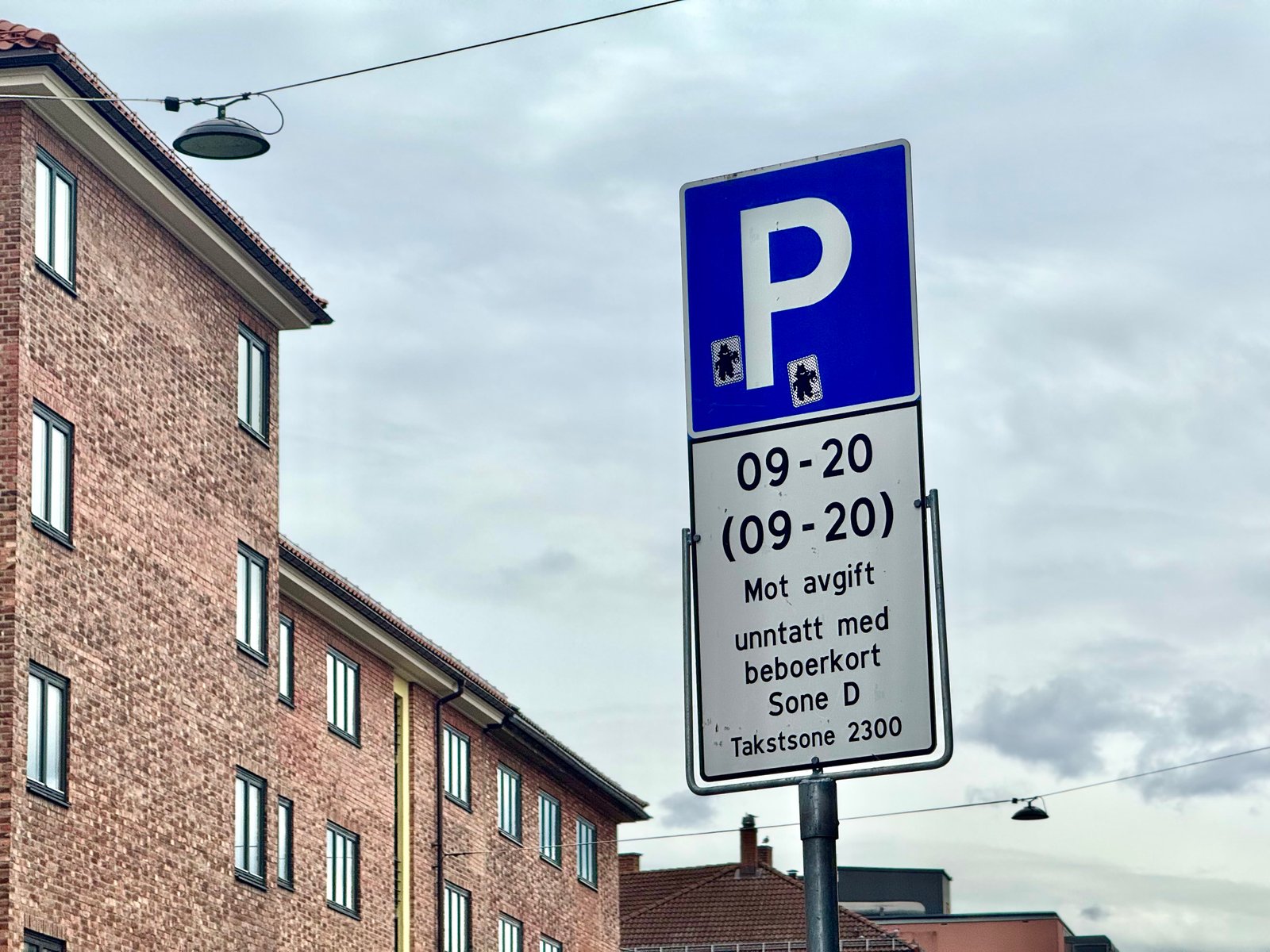
Sign boundaries matter too. A standard sign applies from where it's posted until the next intersection or the next sign. But zone signs (marked "Sone") work differently. They cover an entire area, through multiple intersections, until you see the same sign greyed out with diagonal lines struck through it. That greyed-out sign is the zone termination marker. Everything between the two signs falls under the same rule.
The five-metre rule
Park within five metres of a crosswalk, an intersection, or a bicycle crossing and you will get fined. This is one of the most actively enforced parking rules in the country, and wardens have been known to walk around with tape measures.
The five metres are measured from where the edge of your road meets the intersecting road, or from the nearest painted edge of a zebra crossing. The rule exists to keep sightlines clear for pedestrians and drivers at junctions, and it applies everywhere, at all times, regardless of whether the street has paid parking or not. You can be parked perfectly legally in a paid zone with an active EasyPark session and still get fined because your bumper is four metres from a crosswalk.
In practice, if a spot near a corner looks tight, skip it. There's no marking on the ground to tell you where the five-metre boundary falls.
When parking is free
The sign tells you everything you need to know. Outside the listed hours, parking is free and unrestricted on municipal streets.
As a general pattern across most Norwegian cities: evenings, Sundays, and public holidays are free. In Oslo city centre, paid parking runs Monday to Saturday from 09:00 to 20:00. Park at 20:01 on a Tuesday and you can stay parked for free until 09:00 the next morning. Show up on a Sunday and every municipal street spot is free all day.
Saturday afternoons are free in many municipalities. The exact cutoff varies by city, often 15:00 or 17:00.
EasyPark will show "Free" in the app when a zone has no active fee. You do not need to start a parking session in the app if you're only planning on parking during the free hours.
Private garages and lots (eg. Europark, Aimo)
Private garages and lots play by their own rules. Most charge 24 hours a day, 7 days a week. Shops and malls may give a certain amount of time for free, usually 1-2 hours. The conditions for the free parking is clearly stated and sometimes require you to registering your license plate number on a tablet in the shop. The "free on Sundays" pattern applies to municipal street parking, not to the private garages. Always check the signage at the entrance.
Charging your EV at municipal roadside chargers
Norwegian cities have thousands of public charging points built into regular street parking bays. Oslo alone has several hundreds of them. If you're driving an electric rental car, these are a practical way to top up the battery while you're out exploring.
Often what you pay only covers the electricity, which makes the parking itself virtually free. And because everyone parked there has to be actively charging, often with a limit of maximum 2-3 hours during the day, spots open up more regularly than at a standard parking lot.
EasyPark handles the charging as well. Each charger has an ID number printed on it, and the same chargers appear on the map inside the app. Select the correct charging zone, pick the specific charger outlet that matches the one you're plugged into, and tap Start, wait a couple of seconds for the session to activate. When you come back, stop the charging session in the app.
The sign at the charging bay dictates the rules. Some spots are time-limited to prevent people from hogging a charger all day with a full battery. If the sign says "Maks 3 timer" (Maximum 3 hours) that applies to you regardless of whether you're still charging. Some municipal charging bays charge a fee for the electricity on top of the parking fee, others are free to charge but you still pay for parking during the normal paid hours. Read the sign and follow whatever it says.
Camera garages and "pay later" invoices
More Norwegian garages have switched to barrier-free camera systems. You drive in, a camera reads your plate, and when you leave, another camera reads it again. There's no ticket to lose, no barrier to wait behind, and if everything is set up correctly in EasyPark, the session is handled automatically. Make sure you activate the Automatic CameraPark feature in EasyPark.
The problem comes when it's not set up correctly, or when you don't have an app at all. The camera system generates a "pay later" invoice sent to whoever the plate is registered to. For a rental car, that's the rental company, which pays it, adds a handling fee (typically 200 to 375 NOK depending on the agency), and bills you weeks or months later.
Most camera garages give you 24-48 hours to pay online via the operator's website. If you see a sign at the exit displaying a URL, pay that evening from your hotel. It takes two minutes and saves you the admin fee surcharge.
Parking outside the cities
Trailhead parking
Trailhead parking is where things might get complicated. Popular hikes increasingly charge for parking, but the payment method varies wildly from one trailhead to the next. Some accept EasyPark. Some use GoMarina or other local apps. Some have a QR code that only works with Vipps, a Norwegian mobile payment system that requires a Nordic phone number or bank account, which most foreign tourists don't have. If you hit a Vipps lot, look for a card machine.
Don't park on highway shoulders near popular trailheads, and don't assume that parking is OK just because 5 cars are already standing on the shoulder. It's enforced heavily during summer and carries a 900 NOK fine. Use the designated lots even if they're a 15 to 20 minute walk from where you actually want to be. Arriving early in peak season makes a difference, both for getting a spot and for avoiding crowds on the trail itself.
Tourist hotspots
Tourist hotspots in rural Norway have gotten noticeably stricter about parking in the last few years. Small municipalities with a few hundred residents don't have the road infrastructure for thousands of summer visitors, and cars parked along narrow roads create real problems for emergency access. The response has been more barriers, more signage, more wardens, and camera systems at popular beaches and viewpoints that auto-bill your plate the moment you enter the access road. At some locations, you'll get charged even if you pull in for a quick look and leave again, because the cameras sit on the approach before the actual lot.
If you get a fine
Norway has two kinds of parking fines.
A kontrollsanksjon is issued for standard violations like unpaid parking, an expired session, or parking outside the marked lines. These are capped at three fixed tiers: 330 NOK for minor issues (like forgetting a time disc in a free lot), 660 NOK for the most common tourist mistakes (unpaid parking, wrong zone, expired time), and 990 NOK for serious ones like parking in a disabled spot without a permit.
A parkeringsgebyr is the heavier municipal fine for traffic law violations like blocking an intersection, parking in a no-stopping zone, or obstructing a pedestrian crossing, and can run from 900 to 1,500 NOK.
Most tourists who mess up the app or misread a sign will pay 660 NOK.
Pay immediately if you can. The ticket includes payment details with a KID reference number and bank account. Private operators escalate to debt collection agencies that add their own fees on top. If the fine hits your rental car company before you pay it yourself, they'll add a handling fee of 200 to 375 NOK per incident.
If you think a fine was issued in error, the contact details are on the ticket itself. Private parking fines can be escalated to the national Parkeringsklagenemnda (Parking Appeals Board) if the operator rejects your initial complaint. But "I didn't understand the sign", "I did pay, but entered the wrong licence plate" or "the app confused me" won't get a fine overturned. Norwegian traffic law places the responsibility squarely on the driver to verify the rules before parking.