
By: Chris ⎜ Last updated





Norway uses the same basic European driving rules, but there are a few things visitors need to know. The blood alcohol limit is 0.02%, low enough that a single drink puts most people over. Speeding fines escalate fast, and serious offences are calculated on your income. Winter tyres are mandatory by law between specific dates. And the western coast runs on ferries that need to be considered into your driving plan, not discovered when the road ends at a fjord.
The toll system, the tunnels, and the mountain roads all have their quirks, and requires some preparation.
Renting a car vs driving your own
Whether you rent in Norway or bring your own vehicle changes how you deal with tolls, ferries, insurance, and winter tyres for the trip.
Rental car
If you're renting in Norway, most of the logistics are handled for you. The car comes with an AutoPASS toll tag on the windshield. Every toll point and ferry terminal reads it automatically, and the charges get forwarded to your credit card through the rental company. You'll see an admin fee from the rental company on top of the actual tolls, typically a flat daily or per-transaction charge. There's no way around this, and the fee structure varies by company, so read the fine print. In winter, the car will have winter tyres fitted, these will usually not be studded as studded tyres trigger a daily fee in major cities.
If you're renting and plan to cross into Sweden or Finland, say so when you book. Most major agencies (Avis, Sixt, Hertz, Europcar) allow it, but they charge a cross-border fee and need advance notice to sort the insurance. Swedish congestion taxes in Stockholm and Gothenburg get processed through the same toll system, so that part is seamless.
Your own car
If you're driving your own car, you need to do the setup yourself. Register with EPASS24 before you arrive. It links your licence plate to a credit card so toll charges get billed automatically. If you don't register, the system still photographs your plate at every toll point, but the invoice arrives at your home address weeks later with an administrative fee tacked on. The fee varies by country and adds up fast over a multi-day trip.
If you're staying longer than a week or two, a physical AutoPASS toll tag is worth considering. It gets you a 20% discount on standard tolls and qualifies for ferry discounts. You can order one through providers like Flyt.
Driving licence requirements
If you hold an EU/EEA licence, it's valid in Norway without restriction. Non-EU licences (US, UK, Canada, Australia, and others) are valid for tourist stays of up to 90 days. An International Driving Permit isn't strictly required by Norwegian law for short visits, but some rental companies demand one as part of their own policy.
The toll system
Norway runs a completely barrier-free toll system. There are no booths, no gates, no stopping. Overhead cameras read your licence plate or AutoPASS tag as you drive under the gantry, and the charge appears on your account later. The system is called AutoPASS, and it covers every toll road, bridge, and tunnel in the country.

If you're in a rental car, this is already sorted. The tag already installed in the car handles it. If you're driving your own car, register with EPASS24 as described above.
The toll network is dense, especially in and around major cities. Oslo, Bergen, Trondheim, Stavanger, and Kristiansand all run urban toll rings, sometimes with multiple concentric rings. In Oslo, there are three. Some rings charge only when driving inbound, others charge in both directions. The gantries can be fairly inconspicuous and you might not always notice them.
Rush hour pricing applies on weekday mornings and afternoons in the major cities. The surcharge is typically somewhere around 25–30% above the standard rate. It doesn't apply on weekends, public holidays, or during July. There's also a one-hour rule: within a single toll ring, you're only charged once per hour regardless of how many gantries you pass under. This protects you from being billed repeatedly for short local trips.
Electric vehicles no longer pass through for free, but they still pay substantially less. National rules cap EV tolls at 70% of the standard fossil-fuel rate, and in practice most places charge closer to 50%. The catch: if you're driving your own EV from abroad, you must register the vehicle's emission data with EPASS24 or AutoPASS. If the system can't identify your car as electric, it defaults to the highest petrol/diesel rate.
Diesel vehicles pay slightly higher tolls than petrol in the urban rings.
What the roads are actually like
The main European routes (E6, E18, E39) are well maintained. Near cities you'll get dual carriageways. Between cities it's mostly wide two-lane highway with good surfaces, clear markings, and regular rest areas.
County roads are different. In western Norway and through the northern archipelagos, secondary roads narrow to single-lane stretches that wind along fjord edges and across mountain shelves. The surface is usually asphalt but quality drops, and there are stretches of gravel road in remote parts of the north. Two-lane roads that technically accommodate traffic in both directions sometimes feel like they don't, especially when a campervan rounds the bend ahead.

Passing places
On single-lane roads, blue signs marked with a white "M" indicate a møteplass, a designated passing place where the road widens enough for two vehicles. Whoever reaches the møteplass on their side of the road pulls over and lets the oncoming vehicle through. If you meet another car between passing places, the one closest to an M sign reverses back to it. Never park in a møteplass, not even briefly for a photo. It blocks the only place two vehicles can pass on that stretch of road.
Right of way
The default rule in Norway is yield to the right. At any intersection that doesn't have explicit signage, traffic approaching from the right has absolute priority. This applies in residential areas, small towns, and rural crossroads. If you're used to driving in countries where every junction has clear signage telling you who goes first, this will take some getting used to..
Priority roads are marked with a yellow diamond sign. When you're on one, you have right of way. When the priority ends, a strikethrough diamond tells you, and the yield-to-the-right rule kicks back in.
Roundabouts follow the standard European convention: yield to traffic already in the circle. Trams always have priority, everywhere, regardless of signage.
Pedestrians
Pedestrians at zebra crossings have absolute priority, except for trams. Norwegian drivers are conditioned to stop the moment someone approaches the curb. Therefore, Norwegian pedestrians often don't wait for a gap, they just walk as all (or most) drivers will automatically stop. As a driver, you must stop immediately when anyone is waiting to cross; as a pedestrian, you'll step off the curb and cars will screech to a halt.
Road markings
Norway uses yellow centre lines to separate traffic moving in opposite directions. If you're used to white centre lines from most of continental Europe, this looks wrong at first. White lines in Norway are only used to separate same-direction lanes or to mark the road edge.
A solid yellow line means no overtaking. A broken yellow line means overtaking is permitted, but look at the pattern: long painted segments with short gaps mean visibility ahead is limited. Short painted segments with long gaps mean you're clear, provided the oncoming lane is empty.
Road signs and Norwegian terms
Directional signs follow a colour code. Blue backgrounds point to motorway destinations. Yellow backgrounds indicate standard road destinations. Brown backgrounds mark tourist attractions. White backgrounds are for local destinations, and orange means a temporary diversion.
Most warning signs use standard European pictograms, but supplementary text panels are in Norwegian. A few terms you'll encounter:
| Norwegian | What it means |
|---|---|
| Stengt | Closed |
| Vegarbeid | Roadworks |
| Omkjøring | Detour |
| Møteplass | Passing place |
| Gjennomkjøring forbudt | No through traffic |
Tunnels
Norway has over 1,200 road tunnels. Some are short punches through a hillside. Others are multi-kilometre subsea crossings that descend hundreds of metres below the fjord floor before climbing steeply back up on the other side. The Ryfylke Tunnel near Stavanger drops to 292 metres below sea level across 14.4 kilometres, the world's longest and deepest subsea road tunnel.
You'll drive through a lot of tunnels, and some of them are long enough to feel like an event. The long subsea ones have a distinctive profile. You descend on a steep grade, often 7–8%, for several minutes. There's usually a wide lit chamber at the lowest point where you can pull over if needed. Then you climb the same grade back up.
Dipped headlights are mandatory at all times in Norway, year-round, whether on the open road or inside a lit tunnel. Most rental cars handle this automatically. If yours doesn't, switch them on before you leave the lot and leave them on.
GPS signal cuts out in long tunnels. Some of the subsea crossings have underground junctions and roundabouts where you need to choose an exit. Know your route before you enter. If you're following turn-by-turn directions, your phone will go silent for several minutes and may not recover in time to tell you which branch to take.
If your car breaks down inside a tunnel, use the orange emergency telephone mounted on the wall. Don't use your mobile. Lifting the emergency receiver instantly alerts the traffic control centre and pinpoints your exact location, and it triggers warning lights outside the tunnel entrance to stop more vehicles from entering. Emergency phones are spaced at regular intervals throughout long tunnels.
Speed limits, fines, and the law
Norway's speed limits are lower than most of continental Europe, and the enforcement is significantly harsher. The country operates under a Vision Zero (Nullvisjonen) policy: zero traffic fatalities as a stated national goal. The system is built around that ambition, and the tolerance margins reflect it.
Speed limits
Unless a sign tells you otherwise: 50 km/h in built-up areas, 80 km/h on rural roads are the default speed limits. Residential zones are frequently posted at 30 km/h. Motorways are posted between 90 and 110 km/h. 110 km/h is the highest speed limit in Norway. Vehicles over 3,500 kg and cars towing standard trailers are capped at 80 km/h regardless of what the posted limit says.
Enforcement
Speed cameras are common. There are two types. Spot cameras measure your speed at a single point. A small red flash means the camera is measuring. An orange flash means it recorded a violation. Section control cameras measure your average speed between two points. Common inside tunnels and on high-risk stretches. If your average is at or below the limit, your data is automatically deleted. If it's above, the photo is processed for a fine.
There is no practical tolerance buffer. The cameras are precise, and the system doesn't quietly round down a few km/h in your favour.
Fines
Norwegian speeding fines are severe by international standards. Minor infractions (1–5 km/h over) start around NOK 1,100. Go 20-25 km/h over the limit in a 50 zone and the fine jumps above NOK 12,000, more than 25 km/h above and your license will be confiscated. On freeways you have slightly more leeway, but the fines are high enough to potentially ruin your holiday budget.
The Norwegian Police and Statens vegvesen publish the current fine schedules.
Blood alcohol limit
The legal limit is 0.02% BAC. That's effectively zero. A single glass of wine at dinner will put most people over it, and the threshold leaves no room for interpretation. Police run random breathalyser checkpoints on highways and rural roads alike. The penalties escalate fast: fines calculated on income, immediate licence suspension, and potential jail time depending on the level.
If you're driving, don't drink at all. Not one beer, not half a glass. The margin is too thin to estimate your way to safety.
Mandatory equipment
Every vehicle must carry a reflective safety vest and a warning triangle. The vest needs to be accessible from the driver's seat, not buried in the boot. In a breakdown, the warning triangle goes 100 metres behind the vehicle on motorways, 30 metres on rural roads. Rental cars should have both. Check before you drive off.
Ferries
Ferries in Norway are an integral part of the road network. On the western and northern coasts, the highway regularly ends at a ferry terminal, crosses a fjord, and continues on the other side. Some driving routes hit three or four ferry crossings in a single day. You can't drive the coast without them, and they need to be part of your trip planning.
Most domestic ferry routes operate on a turn-up-and-queue basis. No advance booking, you just arrive and line up in the staging lanes, ANPR cameras read your plate as you drive aboard, and you're billed afterwards.
Paying for ferries
If your rental car has an AutoPASS tag, the tolling extends to ferries and you get a discount. For your own vehicle, register with FerryPay to link your plate to a credit card. FerryPay charges full price (no discount) but it's free to set up and it avoids the administrative invoice fee you'd otherwise pay for each crossing as an unregistered vehicle. For discounts on ferries, you need a separate AutoPASSferje prepaid agreement linked to a physical toll tag.
When to book ahead
A few high-demand routes require advance booking in summer, particularly in July. The Bodø to Moskenes crossing (the main vehicle ferry to Lofoten) and the Geiranger to Hellesylt route across the Geirangerfjord are the most notorious. Vehicle space on these sells out. Book online well ahead of your travel date. On the Bodø–Moskenes route, all passengers must also complete a digital registration (name, nationality, date of birth) before boarding.
Foot passengers travel free on many routes, including the Bodø–Moskenes crossing. Vehicles are charged based on length. Current ferry rates are listed on the AutoPASS ferry pages.
Winter driving
Driving in Norway in winter is a fundamentally different proposition from driving in summer. Routes may take hours longer due to snow or poor and slippery driving conditions. The amount of daylight drops dramatically the further north you go. Tromsø gets no sun at all from late November to mid-January. The road network shrinks as mountain passes shut down, and the roads that stay open demand proper winter equipment.
Clearing your car
Before you drive anywhere in winter, clear all snow and ice from the car. Norwegian police have zero tolerance for what they call "igloo driving" or "peephole driving," where someone scrapes a small square on the windshield and leaves the rest of the car buried. Snow on your roof will slide onto your windshield when you brake, or fly off and blind the driver behind you. Ice chunks from your car can shatter someone else's windshield. Fines are high in Norway, and in serious cases the police may confiscate your licence on the spot. Rental companies provide scrapers and brushes. Use them properly before every drive.
Winter tyres
Winter tyres are mandatory during the winter season: November 1 to the first Sunday after Easter in southern and central Norway, and October 16 to April 30 in the northern counties of Nordland, Troms, and Finnmark. Minimum tread depth is 3 mm for passenger cars. Driving without adequate winter tyres during this period risks a fine and, more importantly, invalidates your insurance.
Rental cars come with winter tyres fitted during the season. You choose between two types: friction tyres (studless) and studded tyres. Studless tyres are by far the most common in the cities and work well most of the time. Studded tyres grip better on sheet ice. Friction tyres are quieter and don't chew up dry asphalt. If your rental has studded tyres and you're driving in Oslo, Bergen, Trondheim, Stavanger, or Kristiansand, you'll need to pay the piggdekkgebyr, a daily studded tyre fee charged by the municipality. The rates vary by city and have increased in recent years. Check the specific city's website or ask your rental company. Oslo's rates are published on oslo.kommune.no.
If you're using studded tyres, they must be on all four wheels. Snow chains aren't legally required for passenger cars, but they're worth having in the boot if you're planning mountain pass routes in heavy conditions.
Mountain passes
Several major mountain passes close entirely during winter. Trollstigen, Sognefjellet, Valdresflye, Gamle Strynefjellsvegen, and others shut down when the snow arrives and don't reopen until late spring or early summer. Exact dates shift each year depending on conditions.
On some routes that stay nominally open through winter, the authorities run convoy driving (kolonnekjøring) if the weather is poor. Vehicles are grouped at a barrier and escorted behind a snowplough. You wait at the assembly point until enough vehicles gather and a plough is available, then you follow it through as a column. This happens on exposed routes in the north, including stretches near Nordkapp, and on mountain passes in the south.
Before any winter drive outside a major city, check the road status on vegvesen.no. The site shows real-time closures, weather warnings, and convoy schedules. Check it on the morning of your drive, not the night before. Conditions change fast.
Darkness
In northern Norway, the sun doesn't rise at all during the darkest weeks of winter. Even in southern Norway, December daylight is limited to a few hours. This compresses your driving window unless you're comfortable driving in the dark, and makes wildlife harder to spot.
Fuel and EV charging
Petrol is expensive in Norway. Norway is one of the largest oil exporters in the world, but domestic fuel is heavily taxed to discourage fossil fuel use. Expect to pay among the highest prices in Europe, roughly 20–25 NOK per litre for 95 octane. Diesel is widely available at similar (or slightly higher) prices. Major chains include Circle K, Shell, Esso, and Uno-X. Many stations, especially in rural areas, are entirely unmanned: automated pumps that accept chip-and-pin credit cards around the clock.
Norway has the densest public EV charging network in Europe, with over 25,000 public charging points deployed across the country, including along remote routes in the far north and through the Lofoten archipelago. Hotels and ferry terminals commonly offer destination charging.
The distinction between fast chargers and standard chargers matters. The fast chargers (50 kW and above, often 150 kW or more) are the ones you'll use on road trips for a quick top-up. Standard destination chargers are slower and better suited to overnight hotel stays.
The main irritation is the payment system. There is no single app that covers every charger, and most chargers do not accept payment cards like petrol stations do. The major networks include Recharge, Mer, Kople, and Eviny (via the Bilkraft app). Tesla has opened most of its Supercharger network to non-Tesla vehicles in Norway. Aggregator apps like Elton consolidate several networks into one payment platform, which helps but doesn't cover everything. Download and set up accounts for at least two or three of these apps before you arrive.
Parking
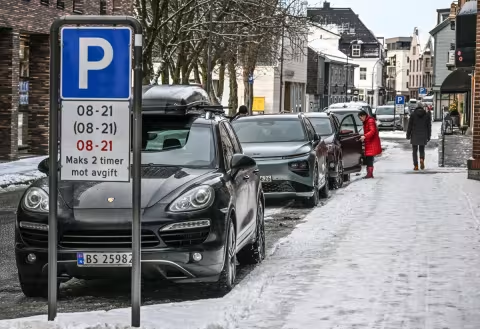
Paid parking in Norwegian cities is almost entirely digital. The EasyPark app dominates the market and works in every major city and most towns. Download it before you go.
Electric vehicles get discounted or free parking in some municipalities. EasyPark detects this automatically if the vehicle is registered as an EV.
Parking enforcement is fast and consistent. If the meter runs out or you're in a restricted zone, you'll have a ticket on your windshield within the hour.
Driving in Norway: Parking rules, signs and EasyPark
Breakdowns and emergencies
Emergency numbers: 112 for police, 113 for ambulance, 110 for fire. For non-emergency medical advice outside regular hours, call 116 117.
For roadside breakdowns, Viking is the main Norwegian roadside assistance service, equivalent to the AA, RAC, or ADAC. NAF (the Norwegian Automobile Federation) and Falck are alternatives. Check whether your rental company or travel insurance includes roadside assistance before you need it.
Mobile coverage in Norway is excellent along highways, in towns, and even inside most tunnels (which are wired with 4G repeaters). Dead zones exist in deep fjord branches, on the interior mountain plateaux like Hardangervidda, and on some remote stretches in the far north. If you're planning drives through these areas, download offline maps beforehand. In winter, carry warm clothing and water in the car. A breakdown without mobile signal in a remote area at minus fifteen is a situation you want to be prepared for.
National scenic routes
Norway maintains 18 designated National Scenic Routes (Nasjonale Turistveger), stretches of road selected for their landscapes and developed with architectural rest stops, viewpoints, and art installations. They include some of the most dramatic driving in Europe: the Atlantic Road's bridges arching between storm-battered islets, the hairpin bends of Trollstigen, and the high-altitude crossing at Sognefjellet, the highest mountain pass in northern Europe.
They're worth knowing about when planning a route, especially if you're choosing between two ways of getting from A to B and one of them happens to be a scenic route. Many have seasonal closures in winter.