
By: Chris ⎜ Last updated

Learn the ins and outs of buying and drinking alcohol in Norway. From supermarkets and Vinmonopolet to strict sales hours, bar prices and local laws, here's what you need to know about what to buy, where and when.
Norway is one of the most expensive countries in the world for a casual beer. It is also, strangely, one of the cheapest places to buy a bottle of fine Burgundy. A 0.4-litre lager at an Oslo bar costs NOK 90-120. A Premier Cru that would run you £150 in London might cost less at the government-run liquor store down the street.
Where you buy what
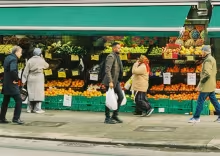
Supermarkets (Rema 1000, Kiwi, Coop, Meny etc) sell beer and cider up to 4.75% ABV. Everything stronger than that, which means all wine, spirits, and higher strength craft beer, is sold exclusively through Vinmonopolet.
Supermarkets - beer
The alcohol sales hours do not follow the opening hours of the store. On weekdays, alcohol sales stop at 20:00, on Saturdays at 18:00. Alcohol sales are not allowed on Sundays and public holidays. This is enforced by the cash register, not by the cashier. There´s no need to argue about it, as there´s nothing the cashier can do. If you show up at the cash register with beer after the cutoff, it will have to go back on the shelves. Convenience stores like Narvesen and 7-Eleven carry non-alcoholic beer and lettøl (light beer under 2.5% ABV), but no standard-strength alcohol at all.
Shopping hours and public holidays in Norway
Vinmonopolet - wine and liquor
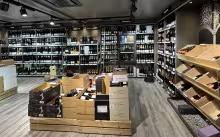
Vinmonopolet, the state monopoly, is universally known as Polet. There are roughly 350 stores nationwide, typically open Monday to Friday 10:00-18:00 and Saturday 10:00-15:00 or 16:00, depending on the store. The stores are always closed on Sundays and public holidays, including extended closures around Easter and Christmas. Check our shopping hours article for more details.
On the plus side, the selection is enormous. Vinmonopolet has close to 35,000 products from around 100 countries, procured through blind-tasting tenders where panels of professionals score wines on quality alone, without seeing labels or brands. A small Sardinian producer competes on equal footing with a multinational wine conglomerate.
Staff are trained to give impartial advice with no commercial incentive to push one bottle over another.
The app is worth downloading to check stock at specific stores, scan barcodes for product information, and order anything in the full catalogue for pickup at the nearest branch. Obviously not all stores carry all items, but everything can be ordered online and delivered to your nearest Vinmonopolet store.
Most products are sold at room temperature, so plan accordingly if you're buying white wine or beer for the evening. And faulty wine can be returned within five years of purchase, no questions asked.
RECOMMENDED: Read our extensive guide to Vinmonopolet
Vinmonopolet liquor store: The complete guide for visitors to Norway
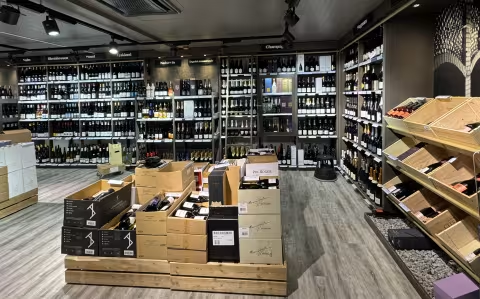
Why expensive wine is cheap
Norway taxes alcohol per unit of ethanol at a flat rate, not as a percentage of the bottle price. A standard 0.75L bottle of 13% wine has roughly NOK 55 in excise duty, which applies whether the wine costs €3 or €300. On top of that, Vinmonopolet adds a transparent, fixed-formula retail markup capped at a maximum per unit, with overall margins running 12-13%. There is no private-profit incentive and no exponential markup on prestige bottles. On top of the final price, 25% VAT is added.
Compare that to how wine gets priced in a country like the UK or the US. A bottle passes through an importer, a distributor, and a retailer, each taking a percentage-based cut. A €200 bottle can easily accumulate 40-100% in combined margins before it reaches the shelf. At Vinmonopolet, the same bottle gets a small, fixed markup on top of the same flat excise duty that applies to the cheapest bottle in the store.
Entry-level wine at Vinmonopolet starts at around NOK 120 and is really poor value, because the tax represents most of the price. But move up to premium bottles and the flat tax becomes negligible relative to the bottle's value. Combined with the capped markup, this means Vinmonopolet is often cheaper than liquor stores in London, New York, or Paris for the same wine.
Vinmonopolet runs themed special release launches throughout the year: Burgundy in February, Bordeaux in December, and Champagne and Chablis in May, where a limited number of sought-after bottles are available at prices that can run to a quarter or a third of what they'd fetch on the international market. Wine collectors camp outside the flagship store at Aker Brygge for days before the most popular releases. Just don't try to find really cheap wine in Norway, it doesn't exist.
Tax-free at the airport
Norway operates tax-free shops on arrival, not just departure. The main store at Oslo Gardermoen is something you cannot avoid. It's located between passport control and customs on international arrivals, and every passenger from an international flight will walk directly through it.
Buy spirits
Spirits are where you can get the largest savings. Norway's excise tax on a 1-litre bottle of 40% spirits amounts to about NOK 370 in duty alone, plus 25% VAT. All of that is reduced to zero at the tax-free shop, however the mark-up is often significantly larger so the prices are not as low as the tax savings would suggest.
Want to try a local speciality? Pick up a bottle of aquavit while you're at it. It's the national spirit, a caraway-and-dill-seed distillate that pairs with cured fish, cheese, and heavy Norwegian food better than anything else. Linie Aquavit, aged in sherry casks that cross the equator by ship, is a better souvenir than anything in a gift shop and costs a fraction of the domestic price at the tax-free.
Skip the wine and beer
Wine at the arrivals tax-free is not the same value proposition. The selection leans toward mass-market travel retail brands, and prices on mid-range bottles are often comparable to, or worse than, what Vinmonopolet charges. The wine excise duty is much lower than on spirits (roughly NOK 55 per bottle versus NOK 370 per litre of spirits), so the tax saving is smaller, and with a higher mark-up than at Vinmonopolet the savings are negligible. Buy wine and beer for convenience when waiting for your luggage, or if you see something you want, not to save any significant money.
The quota
There are three options for travellers arriving from abroad:
- With spirits: 1L spirits + 1.5L wine (2 bottles) + 2L beer
- Wine only: 3L wine (4 bottles) + 2L beer
- Beer only: 5L beer
You also have a tobacco allowance of 200 cigarettes for non-resident tourists. You can swap spirits down to wine or beer, and wine down to beer, but you cannot swap up. The tobacco-for-alcohol swap that older guides might mention was abolished in 2022. You must be 20 or older to import spirits, and 18 for beer and wine. For travellers wanting to bring more than the quota, the Norwegian Customs app (Kvoteappen) lets you declare excess and pay duty digitally before walking through the green channel.
Drinking out
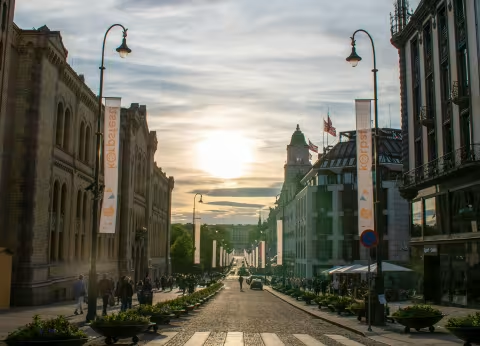
A 0.4-litre lager at a bar in central Oslo runs NOK 90-120 in neighbourhood spots (Grünerløkka, St. Hanshaugen, Tøyen), and up to NOK 150 in tourist areas along Aker Brygge or Karl Johans gate. Other cities are a touch cheaper. Craft beer at specialist bars runs NOK 120-200 for a 0.3-litre serving depending on style and ABV. Wine by the glass typically goes for NOK 150-180 for the cheapest option, while cocktails are typically NOK 150-220.
Most Norwegian bars pour 0.3L or 0.4L, not UK or US pint measures. This makes prices sometimes look lower than they are because the serving is smaller.
Norwegian law bans all cost-based promotions on alcohol. There are no advertised happy hours, no two-for-ones and no advertised drinks specials.
Last call varies by municipality. Oslo allows service until 03:00, the national maximum. Much of the rest of the country closes at 02:00. Spirits cannot be served before 13:00 anywhere in Norway, so unfortunately no Bloody Mary with your hotel breakfast anywhere.
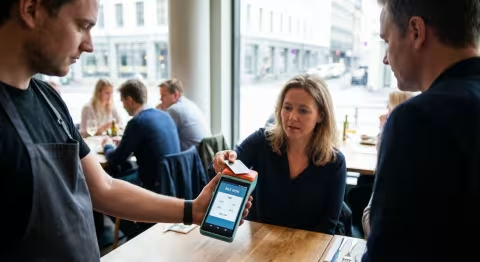
Tipping is not expected, as Norwegian hospitality workers earn a living (often tariff) wage. Rounding up or leaving 5-10% for good sit-down service is generous and appreciated. At a bar counter, tipping is uncommon. Card terminals usually offer a tip option, but you can skip it or press "No tip" without guilt.
Tipping in Norway: What´s expected
Craft beer and cocktails
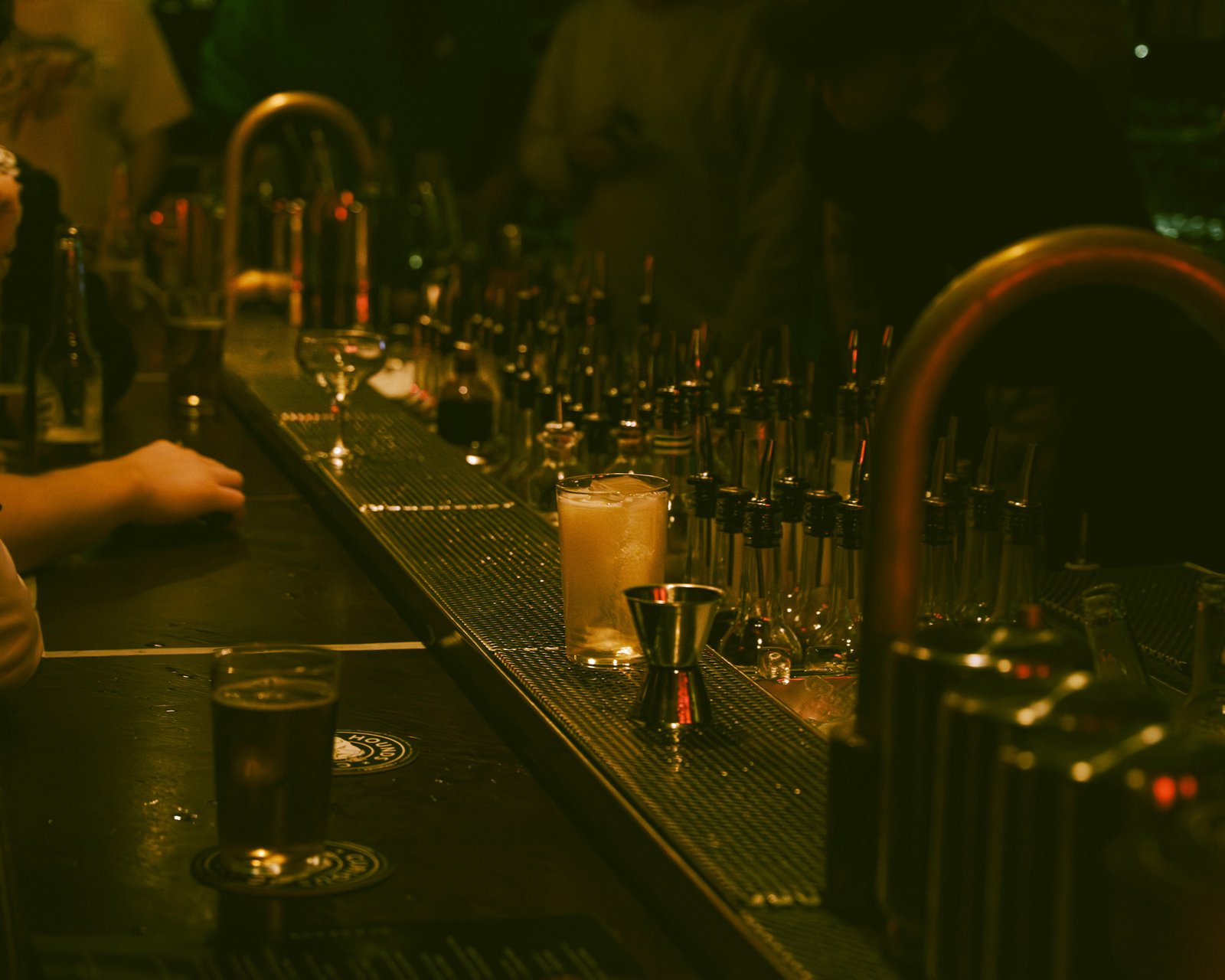
For craft beer in Oslo, Crowbar on Torggata has a huge rotating tap selection across two floors. RØØR on Rosenkrantz' gate has a whopping 70+ craft beers on tap. For cocktails and spirits, Himkok on Storgata distils its own vodka, gin, and aquavit on-site in a speakeasy setting, and has for several years ranked among the World's 50 Best Bars. Svanen, a few blocks away, is a smaller, low-key cocktail bar that takes its drinks just as seriously without the international profile. In Bergen, Henrik Øl & Vinstove runs 50+ taps in a no-music, conversation-first setting, and Apollon Platebar combines Norway's oldest independent record store with 30-plus craft beers on tap.
Rules and regulations
Norway's legal blood alcohol limit for driving is 0.02%. For practical purposes, that means zero, it means you cannot drink if you plan to drive. Even just one standard beer puts most adults over the limit. Penalties are hefty. Fines are scaled to the driver's gross monthly income and for serious cases the penalty can include jail time. If any alcohol is involved, take public transport or a taxi.
The legal drinking age is 18 for beer and wine and 20 for spirits over 22% ABV. Both are enforced at every point of sale. Anyone who looks under 25 should expect to show ID at Vinmonopolet and at bars.
Drinking in public spaces, parks, streets, and squares is illegal, with fines up to NOK 10,000. This is rarely enforced, however. During the summer, Oslo police generally look the other way in parks like Frognerparken and Sofienbergparken as long as people are quiet, tidy, and drinking from discreet cans.