By: Chris ⎜ Last updated
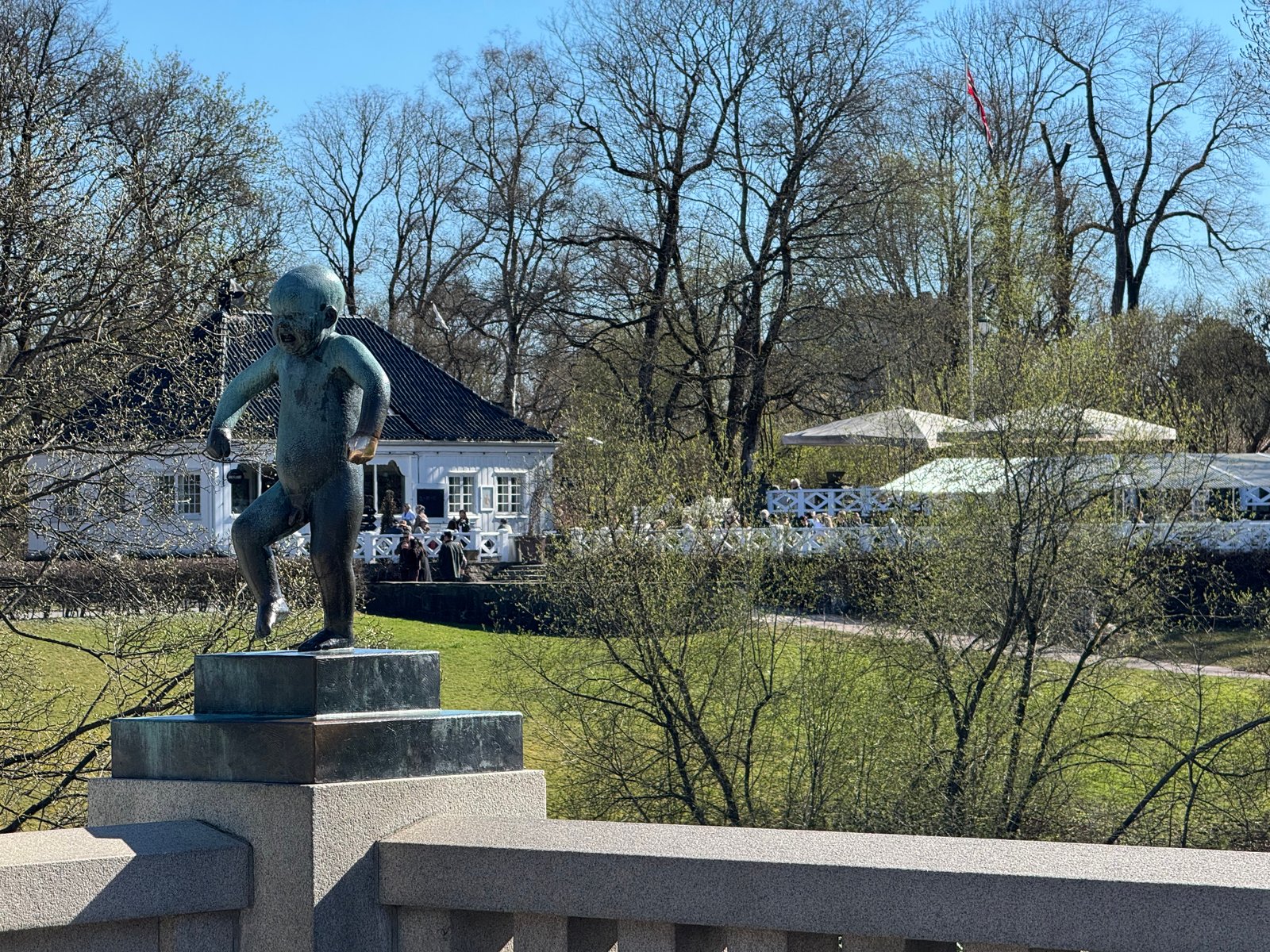
This is the "Mona Lisa" of Oslo. And just like the Mona Lisa, you might be surprised of how small it is.
Standing on the bridge in Vigeland Sculpture Park, Sinnataggen (The Angry Boy) is a bronze toddler having a full-blown, foot-stomping tantrum. Fists clenched, shoulders hunched, one foot raised and mouth wide open in a gut-wrenching scream. He's about a metre tall, including the base, which makes him roughly life-sized for an actual toddler. You might be surprised by his relatively small size, dwarfed by the 57 other sculptures lining the bridge around him, hidden in a corner behind other statues.
The comparison to the Mona Lisa isn't just about scale. Walk past on a summer afternoon and you'll see a crowd with raised phones and people jostling for a position to do the obligatory pose.
Why everyone stops here
There are 58 bronze sculptures on this bridge, and many of them are technically more complex, more emotionally layered, and most are physically larger. Sinnataggen gets all the attention anyway. Nobody has a fully satisfying explanation for why, but the best one is the simplest: he's throwing a tantrum, and every human being on the planet recognises the feeling. The face is so precisely sculpted that it´s both funny and uncomfortably real at the same time.
On Vigeland's first sketch of the drawing in 1901, he simply wrote "A Child" on the drawing. It took nearly four decades before the bronze version ended up on the bridge in 1940. The name Sinnataggen, which translates roughly to "angry little one," wasn't even Vigeland's. A journalist coined it after seeing the sculpture in the artist's studio and writing that it was a little angry fellow who could make a bulldog smile.
Don't touch him
When you get close, you'll notice his left hand gleaming gold against the dark patina of the rest of his body. Parts of his feet and other areas have the same shine. This is from millions of tourists grabbing hold of him.
It doesn't bring good luck, just corrosion. The oils and acids from human skin strip the bronze of its protective patina. The museum has gone to great lengths trying to protect the statue, including wax coatings, dark fluid treatments, and letters to tour guides asking them to stop encouraging the ritual.
The museum's own line on this is worth repeating: "We say it is good luck NOT to touch the art." The detail in Vigeland's modelling is slowly wearing away under all those hands.
When to see him without the crowd
The park is open 24/7, it's free, and ungated.
While the park will never really feel crowded due to the size, if you don't want to fight with others to take photos of the statue, come early in the morning when the bridge and rest of the park is nearly empty. You can stand in front of Sinnataggen (and all other sculptures in the park) for as long as you want, actually study the expression, and take a photo without twelve strangers in it or other people waiting for their turn. Summer evenings after 18:00 work too, and the lighting at that hour is better for photography than the flat midday glare.
The four children on the bridge
Sinnataggen isn't standing alone by accident. He's one of four child sculptures placed at the corners of the bridge's central section, each showing a completely different emotional state. One interpretation, put forward by Norwegian author Roy Jacobsen, links them to the four classical temperaments: the choleric (Sinnataggen, obviously), the melancholic, the sanguine, and the phlegmatic. Whether Vigeland intended that or not, the contrast between the four is striking once you know to look for it.
Finding him on the bridge
If the bridge is busy, look for the knot of cameras on the left side as you walk away from the main gates (heading towards the fountain). If it's quiet, look for the shining gold hand against dark bronze. He's positioned on the south-facing corner of the central section, at railing height.
The rest of the bridge
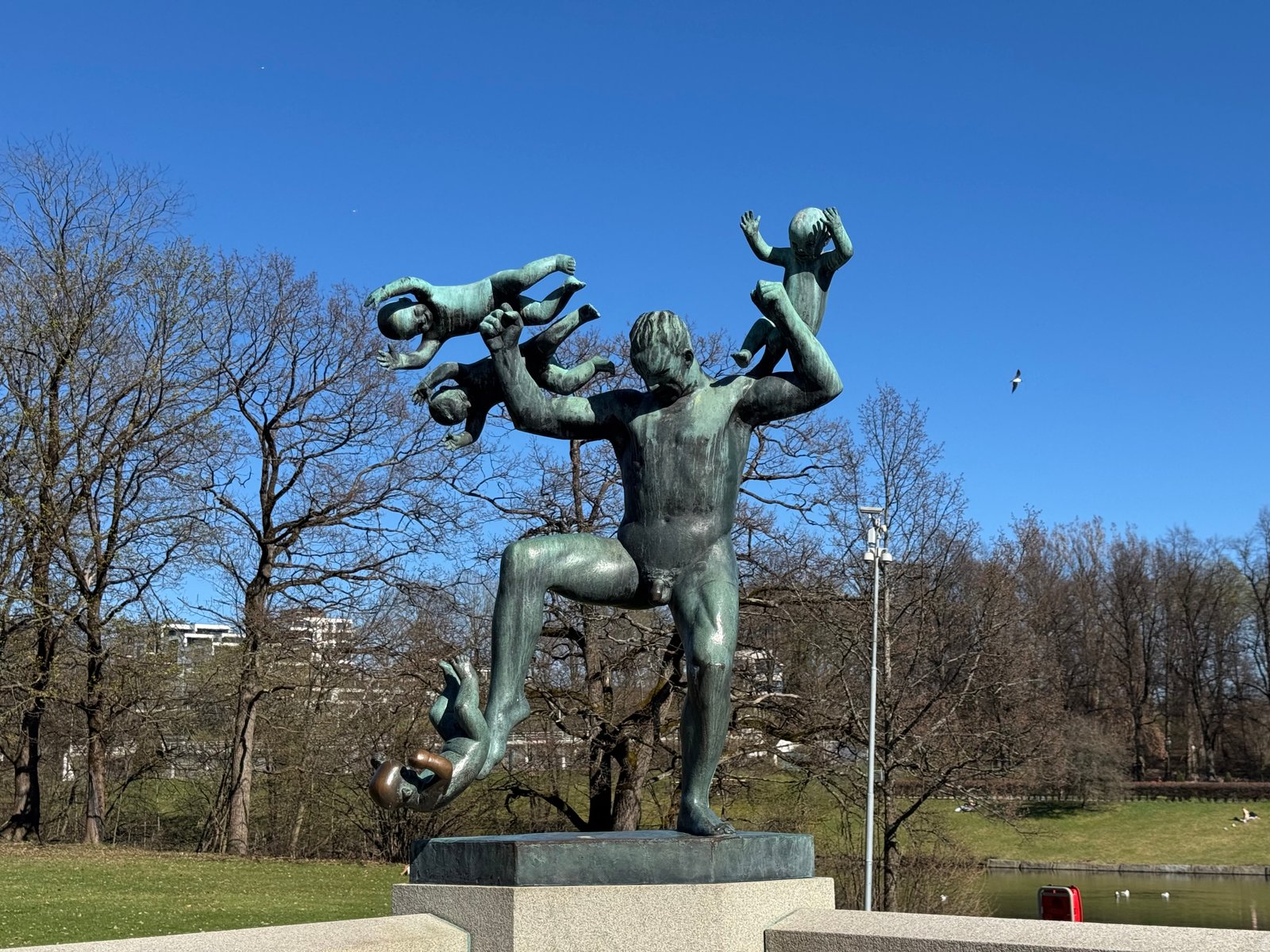
The bridge has 58 sculptures in total, and blitzing past all of them to reach Sinnataggen is a common mistake. Slow down. The sculptures cover the full span of human relationships, from a father tossing a child in the air to couples locked in embraces that could be either love or combat. One figure of a man being attacked by four flying babies (officially titled "Man Chasing Four Geniuses") is almost as popular as Sinnataggen once people spot it.
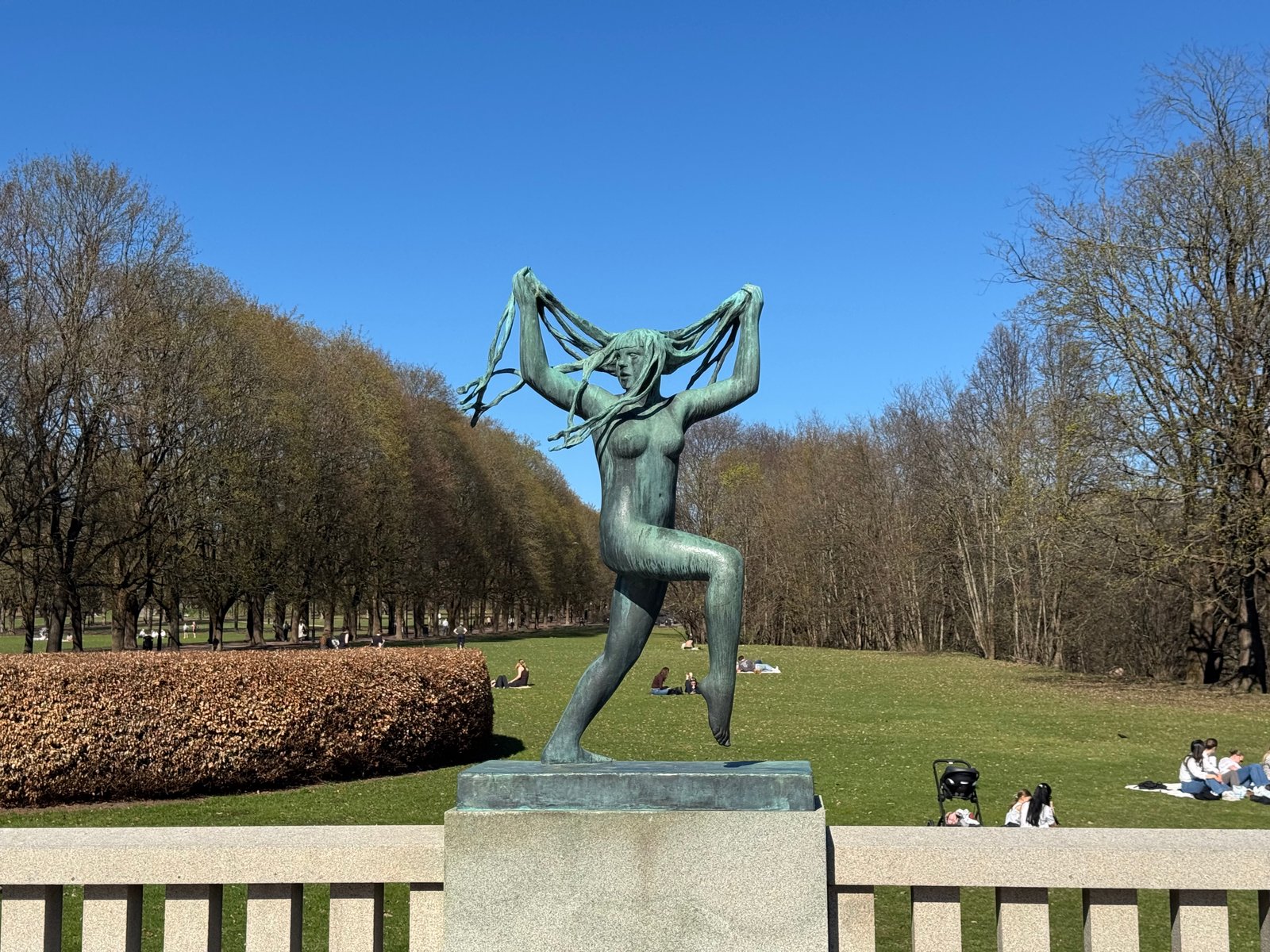
The woman pulling her own hair while appearing to run is another one that stops people. Nobody has a definitive explanation for her, and that's part of the appeal. Vigeland rarely titled his works and never explained them.
The troubled history
For a small bronze toddler, Sinnataggen has had a rough life. On New Year's Eve 1991, someone sawed through his ankle and stole him from the bridge, leaving only his left foot behind on the pedestal. He turned up eleven days later in a car park and was reattached, this time reinforced with internal iron structures. That reinforcement came in handy in 2004, when someone tried to steal him again and couldn't break him free. In 2012, graduating high school students painted him red. In 2021, vandals sawed at his left ankle again, and he had to be removed for restoration before going back on the bridge a couple of weeks later.
The city installed surveillance cameras around the statue in 2005 but has avoided putting up barriers. Vigeland's art should remain accessible and open to people. That openness is part of what makes the park work, even if it occasionally gives the museum a conservation headache.
The rest of the Vigeland Park
Obviously you don´t come here just for Sinnataggen. Read our main article for all about the Vigeland Sculpture Park, including what else to see, where to eat and how to structure your visit.
What to do nearby
Hotels nearby