
By: Chris ⎜ Last updated
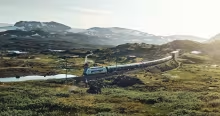
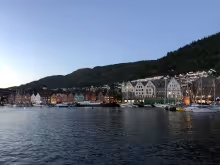
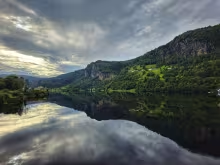
The Bergensbanen is a 470 km train line between Oslo and Bergen which takes about seven hours, climbing to 1,237 metres at its highest point. That makes it the highest mainline railway in Northern Europe. The track has 182 tunnels, and crosses Europe's largest high-mountain plateau, then drops through fjord-edge cliff faces on its way to the west coast.
Bergensbanen was constructed between 1894 and 1909 by crews working with dynamite and hand tools in pool working conditions. Somewhere around the four-hour mark on the way from Oslo to Bergen, the train breaks above the tree line onto Hardangervidda, the vast empty plateau in the middle of Norway.
The smart move is to break the journey with a stopover or two. The stations along the plateau give you access to landscapes you can't reach by road.
The tickets
Book on vy.no or the Vy app. The pricing is dynamic, so you will pay less the earlier you book. A low fare ticket bought well in advance can cost less than 300 NOK one way, but the downside to the cheapest tickets is zero flexibility. It's not possible to do any changes, there's no refunds and no seat selection (you get allocated a seat). The Standard ticket costs more but lets you change your departure or get a full refund.
There are typically four to five daytime departures in each direction, plus a night train. Timetables change, so check Vy for the current timetable.
Vy Plus
You should consider upgrading to Vy Plus. For a seven-hour ride, the upgrade gets you wider seats in a quieter carriage, and unlimited freshly ground coffee and tea for the duration of the journey. Standard class is perfectly fine, but Plus makes a long journey more comfortable. Note: The cheapest non-flexible fares do not allow you to upgrade to Plus.
If you're using an Interrail or Eurail pass, it's valid on the Bergen Line, but you'll need a seat reservation (budget around 100 NOK).
Which side to sit on
Travelling Oslo to Bergen, book a seat on the left side. That puts you facing south, and it's the better side for the journey's centrepiece: the Hardangervidda plateau crossing. When the train climbs above the tree line between Geilo and Myrdal, the big glacier views and the full sweep of the plateau open up to the left. The Hardangerjøkulen glacier is on the left.
The right side is best for the last part of the journey. Between Voss and Bergen, the fjord views and the deep coastal inlets are better from the right. And in the Raundalen valley west of Myrdal, the right side gives you the best view to the waterfalls and the sheer valley drop.
If you're travelling Bergen to Oslo, flip it. Right side for the plateau, left side for the fjords on departure.
In July and August, the train runs at or near full capacity. Pick your seat early when booking. In shoulder season, the carriage is often half-empty and you can roam freely.
What you'll see
The green climb - Oslo to Geilo
Roughly 2.5 hours. Out of Oslo, the train traces the Drammenselva river, skirts the shore of Tyrifjorden (Norway's fifth-largest lake), and pushes into the Hallingdal valley. Here you'll see forested hills and traditional timber farms. The terrain climbs gradually up the mountain.
The plateau - Geilo to Myrdal
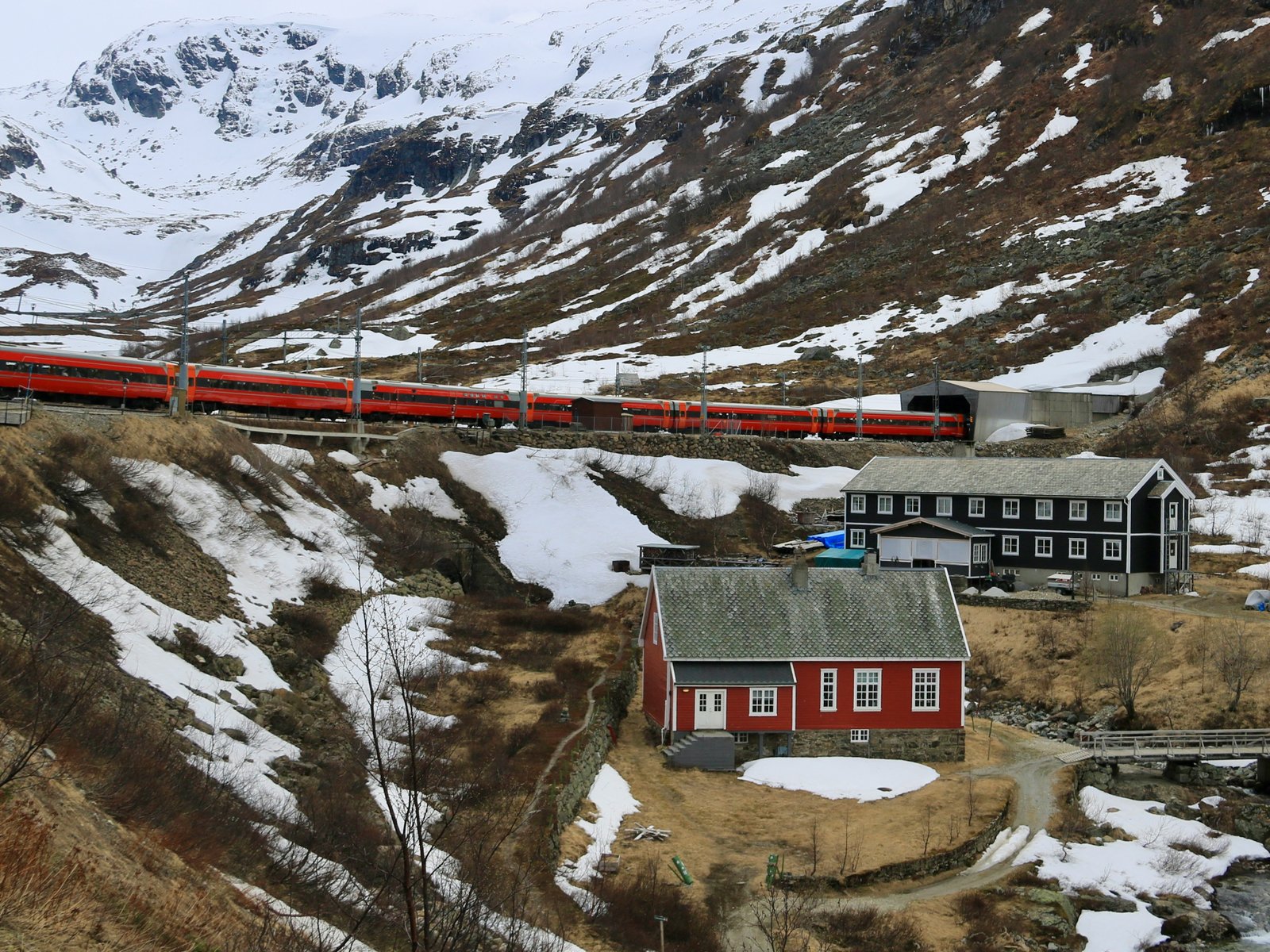
Roughly 2 hours. Past Geilo, the forests thin, and then above the tree line, the Hardangervidda opens up: white, grey-blue, and the muted brown of lichen and exposed rock, stretching further than you can see in every direction. The plateau contains numerous snow sheds designed to protect the train during winter, frequently plunging the train into darkness before spitting you back into broad daylight.
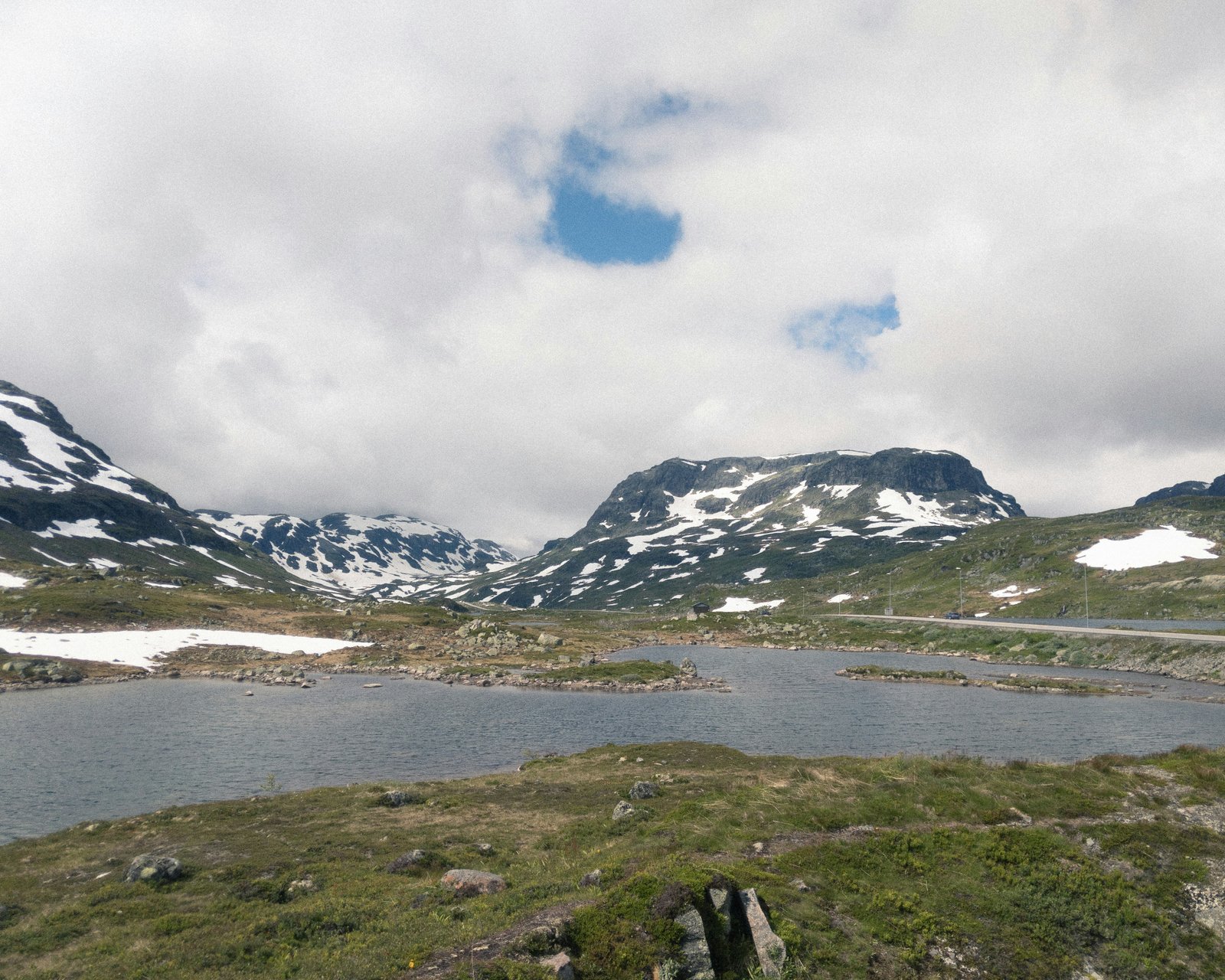
Finse station at 1,222 metres
This is the visual high point with the Hardangerjøkulen glacier visible on the horizon. This landscape was used as filming location for the ice planet Hoth in The Empire Strikes Back. Nothing but ice and rock in every direction.
The western part - Myrdal to Bergen
This part is roughly 2.5 hours. After Myrdal, the terrain drops fast. Vertical cliffs, waterfalls falling into deep gorges, and welcoming green valleys after two hours of snow and rock. The track clings to the sides of the Raundalen valley, following the river as it churns through narrow passages. Approaching Bergen, the fjords appear. Then you get to the Ulriken Tunnel, and you're in Bergen.
Stopovers
While most people either do the train ride in one go, or opt for the Norway in a Nutshell route, there are some other notable stopover opportunities on the way.
Finse: The isolated stopover
About ten people live here permanently. There are no roads. You can only arrive by train, by bicycle, or on foot.
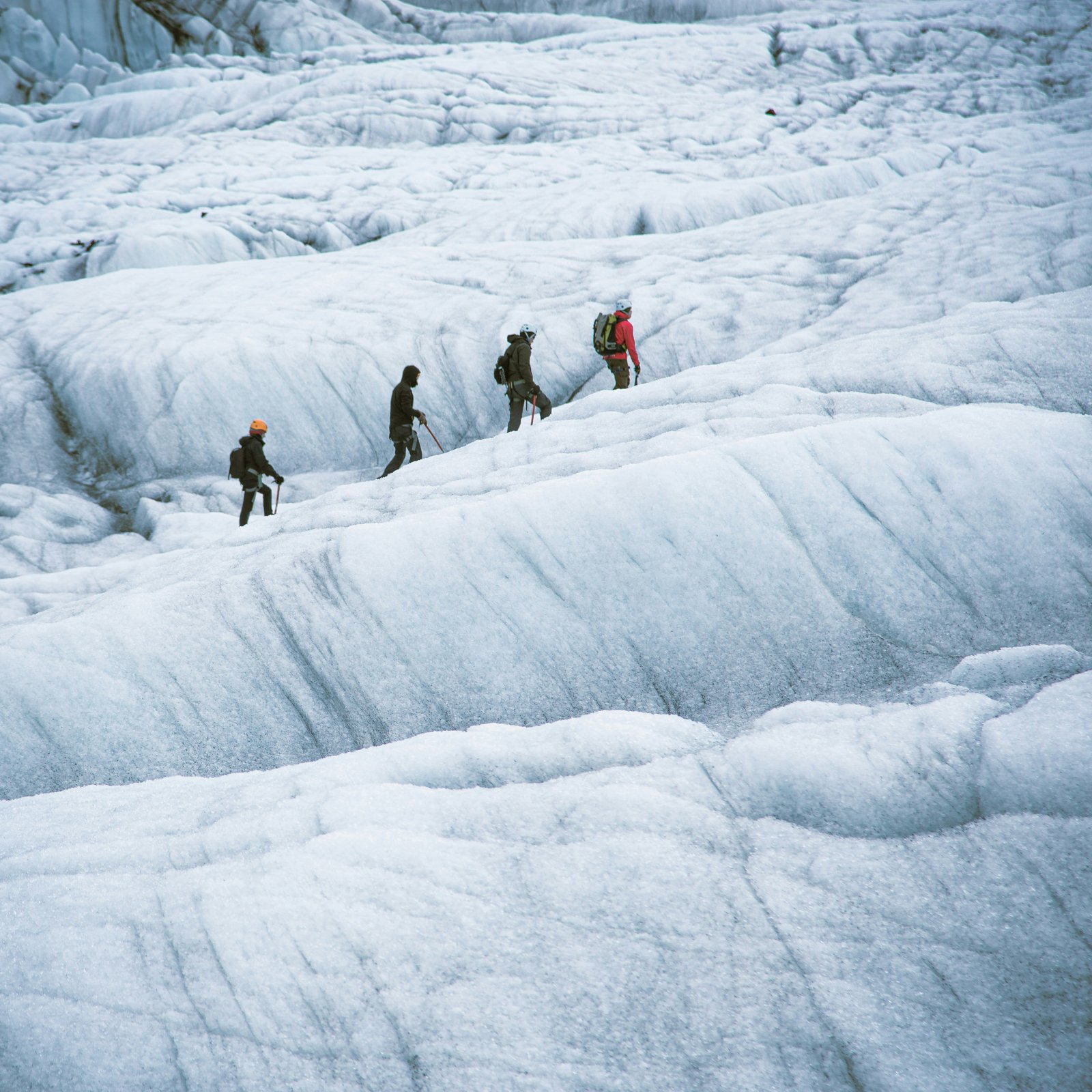
If you have not done a glacier walk before, book a guided glacier walk on Hardangerjøkulen in advance. Visit the Rallarmuseet (Navvy Museum) to understand the brutal story of the workers who built this railway through arctic conditions with hand tools. In summer you can cycle a section of the Rallarvegen, see below.
Hotel Finse 1222 is the only proper hotel, and it's a remarkable one. Originally built in 1906 as a lodge for the railway construction crews, it reopened as a hotel in 1909 and has hosted everyone from the Prince of Wales to the Star Wars film crew. In 2020, Snøhetta was brought in for a careful renovation, and it was a successful one.
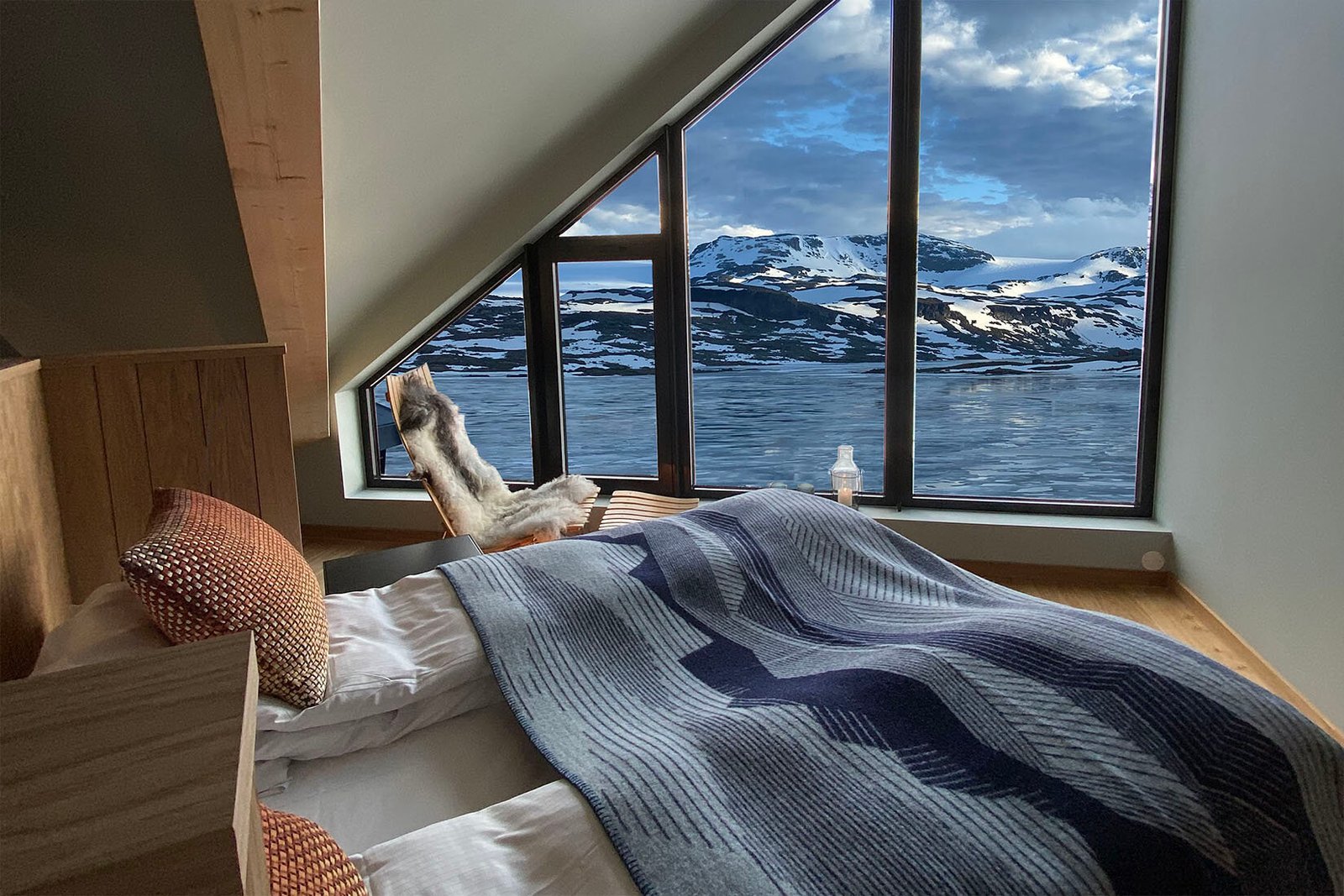
The reception and lounge glow with warm oranges and reds, drawn from the alpenglow on snow. The lounge bar, called Blåsalen (the Blue Room), is painted deep indigo to amplify the "blue hour," those winter evenings when the sunset turns the entire landscape surreal shades of cobalt.
Sit by the panorama windows with a glass of wine and watch the light shift from gold to blue over about twenty minutes. The dining room features William Morris wallpaper inspired by fabric discovered in the attic during the renovation.
There are 45 rooms, including two rooftop Jøkul suites that Snøhetta created by lifting the roof. Floor-to-ceiling glacier views. Bathtubs positioned to look out at Lille Finsenut mountain. Book those suites early, they sell out fast.
Finse has two distinct seasons: winter (November to June) and summer (July to September). The hotel closes between seasons.
For something more basic, Finsehytta is a staffed mountain lodge run by the Norwegian Trekking Association (DNT). Finsehytta is simpler and popular with hikers and ski tourers who don't need design hotels.
The Rallarvegen - Late July to mid-September only
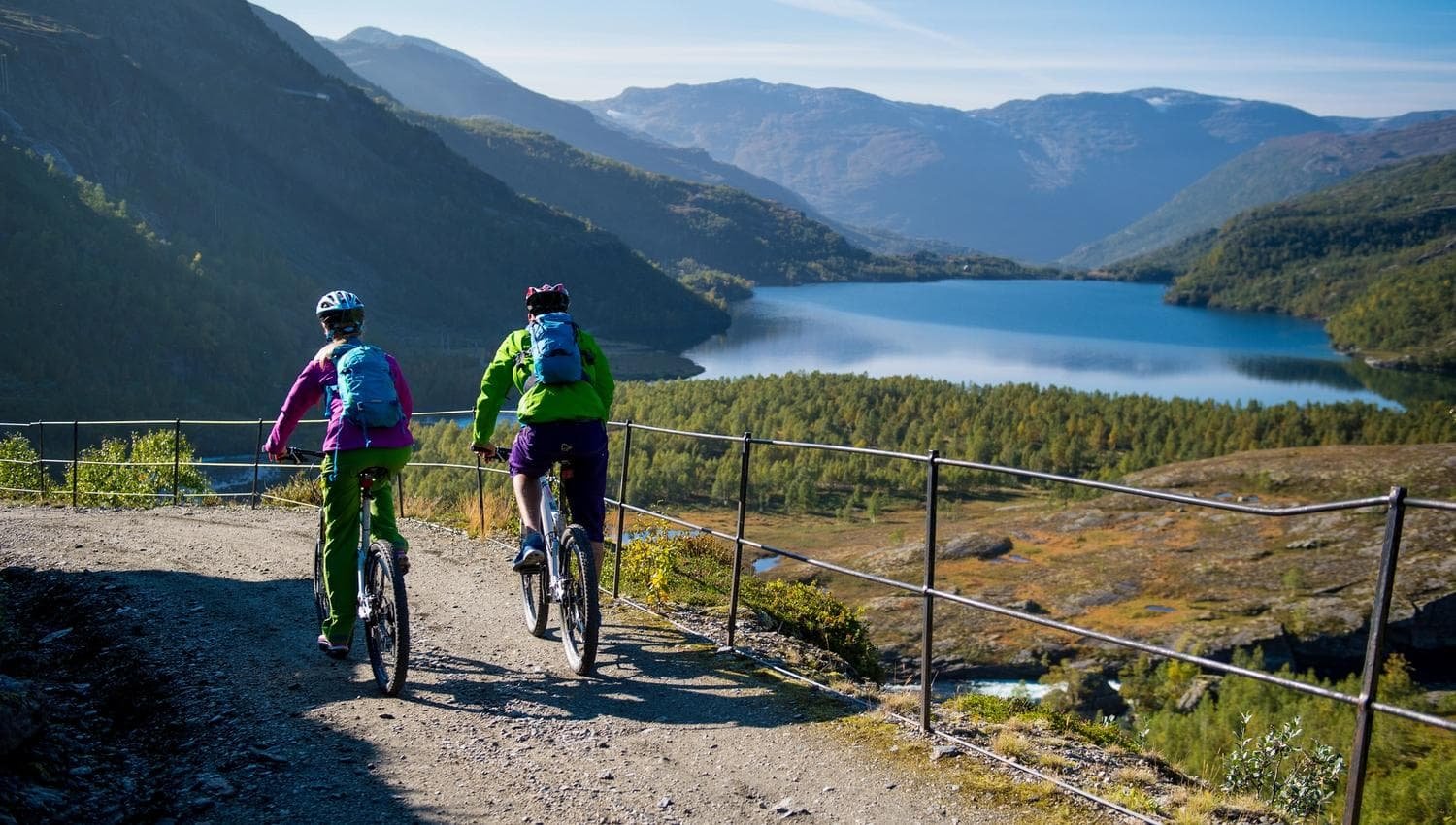
The Rallarvegen (Navvy Road) is an 80 km gravel cycling route that follows the old supply road the railway builders used. It runs from Haugastøl to Flåm, tracing the high plateau before plunging into the western valleys.
The most popular segment is the 27 km ride from Finse down to Haugastøl. This direction is good as it's mostly downhill and manageable for reasonably fit cyclists. There's snow and rock on both sides and barely another person in sight. Rent a mountain bike at Finse 1222 and drop it off at the Haugastøl station before catching the next train back to Finse.
Bike rental is available at Finse 1222 and Haugastøl, with the option to drop bikes at other stations along the route. The surface is unpaved occasionally rocky gravel, and the western descent towards Flåm has steep, unprotected drop-offs (not part of the Finse to Haugastøl section).
The season is short, starting late July and running until mid-September. The snow melts late and arrives early at this altitude. Deep snowbanks routinely block the cycling path well into July. The safest time to plan a Rallarvegen cycling trip is for August.
Voss: Farm food, craft beer, and a gondola
While Finse is all about isolation, Voss is culture and flavour. It sits in the transition zone between the high mountains and the western fjords, and the food and drink here are some of the most interesting on the entire Bergen Line.
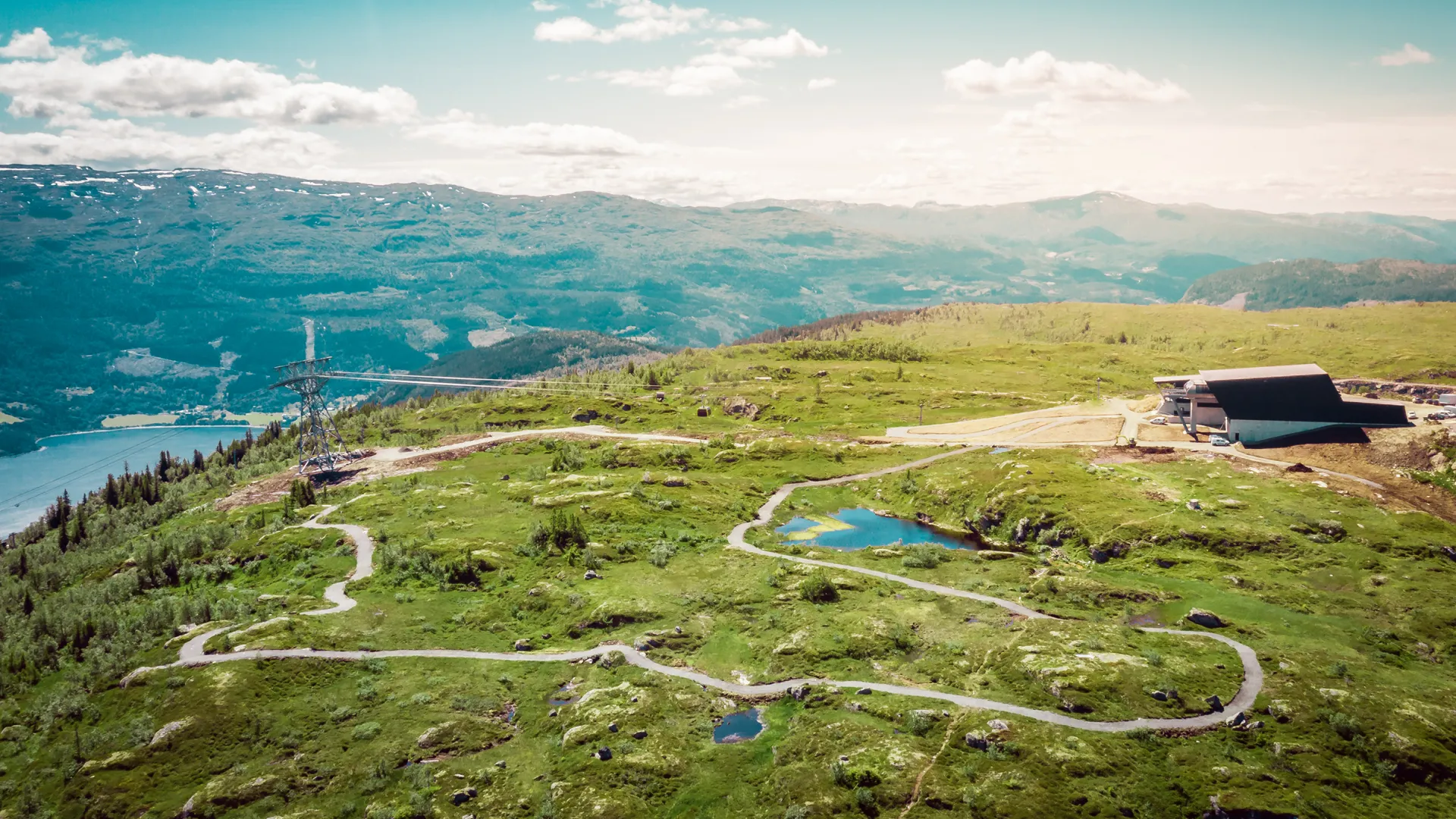
The Voss Gondol departs directly from the train station platform. Step off the train, walk thirty metres, and you're rising up to Mount Hanguren for wide views over Vangsvatnet lake and the surrounding peaks. If adrenaline is your thing, Voss is Norway's extreme sports capital (skydiving, paragliding, whitewater rafting).
Where to stay
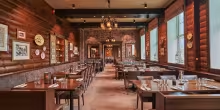
Fleischer's Hotel is located right next to the station, just a few steps from the platform. The building dates back to the 1860s, with the Swiss-chalet exterior going up in the late 1800s. The hotel is a fifth-generation family operation. The grand dining room has dark wood panelling, and tall windows looking out over the lake. Not every room matches the lobby's promise, though.
Book a lake-view room in the historic wing. Those have the best layout, and views over Vangsvatnet. There's a pool, sauna, and a proper bar with a deep wine cellar downstairs. The location is unbeatable if you're arriving by train.
Store Ringheim is a more interesting property, a ten-generation farmstead converted into a 15-room boutique hotel, with exposed timber walls and a setting at the base of Hangur mountain surrounded by working agricultural land. The rooms in the old farmhouse date to 1860. In the early morning the fog lifts off the fields, the mountains appear behind it, and the only sound is birdsong and someone setting up breakfast downstairs.
It's a 30-minute uphill walk from the station, though. Don't attempt it with a lot of luggage. They offer a station pickup service on request, so arrange it when you book.
Where to eat
Restaurant Flor'n at Store Ringheim is in a converted barn on the farm. The kitchen processes its own meat on site using old recipes and forages herbs, mushrooms, and berries from the surrounding hills. The menu changes with the seasons and whatever the farm and local producers can supply that week. Open Thursday to Saturday year-round and daily in summer.
Voss is the heartland of Smalahove: salted, smoked, steamed sheep's head. It's traditionally served in autumn and the weeks before Christmas. A half-head arrives on the plate, looking right at you. The meat is exceptionally tender with a deep, smoky richness similar to pinnekjøtt (cured lamb ribs). You start with the fattiest parts: the ear and the eyes, then take the tender meat from the jaw. Certainly not for everyone, but nothing else on this trip will give you a better dinner table story.
When to Go
Late May to early June is the best window for a pure scenic ride. The eastern valleys have turned bright green, and the plateau is still buried in snow. Passing between the two in the space of an hour is one of the most dramatic visual transitions you'll see from a train window anywhere. As a bonus there are fewer tourists than peak summer, too.
July and August are the only months for cycling the Rallarvegen, and the weather is the warmest, which matters if you plan to do a stopover at Finse. Trains are frequently full however, so book well in advance.
February to March will give you the full Arctic experience. Snow tends to bury the landscape higher than the train windows. Travel late February or March rather than mid-winter, because you need daylight to actually see the plateau. December and January are too dark.
Skip the night train if this is your first time. It exists, it's practical, the PlusNight lie-flat seats are comfortable. But sleeping through the Hardangervidda is like paying for a concert and wearing earplugs.
What to Wear on the Plateau
The Norwegian saying goes: "Det finnes ikke dårlig vær, bare dårlige klær." There's no bad weather, only bad clothes. You can board the train in Oslo in bright sunshine, hit a blizzard at Finse, and step off the train in Bergen with sideways rain.
If you're stopping at Finse or doing any outdoor activity, ensure you pack properly. Merino wool base layer, fleece or heavy wool mid-layer, fully waterproof and windproof outer shell at any time of the year. Avoid cotton or denim. Both absorb moisture and dry slowly, which at altitude means you'll be cold and miserable quickly. Gore-Tex hiking boots are highly recommended if you're not spending all your time at the hotel bar.