By: Chris ⎜ Last updated
The Royal Palace sits at the top of Karl Johans gate. The interesting thing about it isn't the building itself, which is modest by any European standard. It's how close you can get.
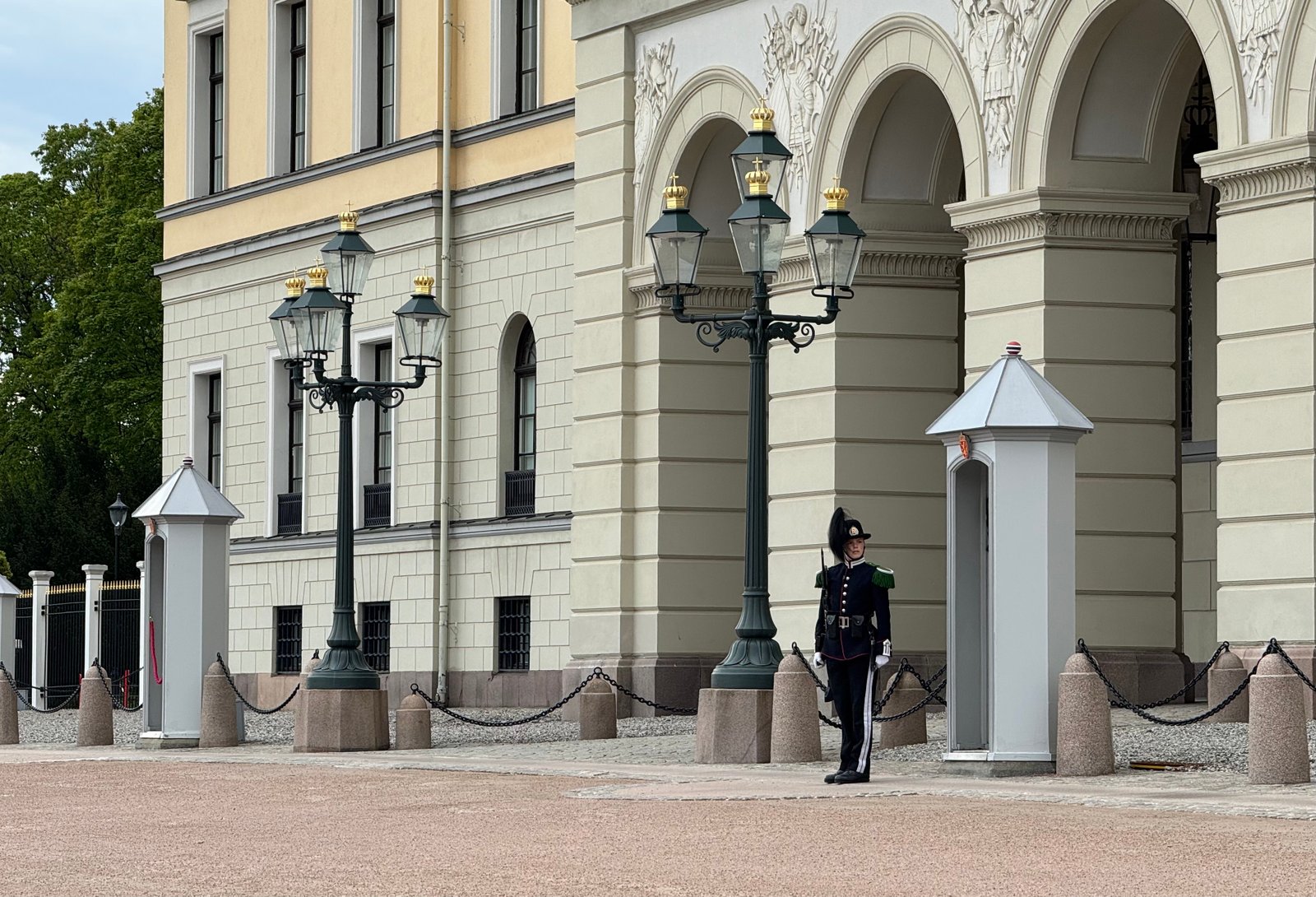
There are no gates, no railings, no crowd barriers. You walk straight up the gravel slope of the Palace Square and stand a few metres from the front door of a working royal residence. The guards are real soldiers from His Majesty the King's Guard, armed and on 24-hour duty, but they're relaxed about visitors. Ask politely and most will pose for a photo, as long as you stay outside the arc. Try that at Buckingham Palace.
This is a palace where the king still lives, still works, and still presides over the Council of State most Fridays. The flag flying above tells you whether he's in. And yet anyone can wander up and have a look around.
The walk up Karl Johans street
Karl Johans gate runs in a straight line from Oslo Central Station, past the Cathedral, past Stortinget (the Parliament building), past the National Theatre, and gently uphill to the palace at the far end. It's about 15 to 20 minutes on foot from the Central Station. The palace grows larger as you climb, and by the time you reach the Palace Square (Slottsplassen), the open gravel square in front of the building, you have reached your destination.
If you'd rather skip the walk, Nationaltheatret is the closest transport hub, served by the T-bane, trams, buses, and commuter rail. From there it's a gentle two-minute stroll into the park.
What to expect
The Royal Palace was completed in 1849 and designed in neoclassical style. It's handsome enough, but if you've been to Versailles, Schönbrunn, or the Royal Palace in Madrid, recalibrate your expectations now. The facade is plain stuccoed brick. The columns are elegant but restrained. The building reportedly has (only) 173 rooms, which makes it one of the smaller royal palaces in Europe.
The simplicity tells you something about Norway. This is a country where the crown prince's family lives in a villa in the suburbs, and the king rides public transport on occasion. The palace matches the monarchy: functional, dignified, and deliberately unpretentious. Some visitors find that disappointing.
The changing of the guard
Every day at 13:30, the King's Guard performs the changing of the guard on Slottsplassen. It's free to watch. The new guards arrive from their camp at Huseby and normally march through the park behind the palace. They meet the outgoing guards at the guardhouse on the right side of the palace, swap positions at several posts around the building, and that's about it.
Set your expectations appropriately. This isn't the Horse Guards Parade or the ceremony at Stockholm's Royal Palace. The whole thing takes 10 to 15 minutes. After the initial march and some shouted commands, the soldiers stand motionless for an extended period, and a fair number of spectators drift away at that point.
During summer, roughly April to September, the guard march starts at Akershus Fortress and follows a route through Kirkegata and up Karl Johans gate. The most watchable moment is the approach, when the guards accompanied by a marching band come up the hill in front of the palace. If you happen to be in the area around 13:00, stick around. If you're across town, don't rearrange your day for it. If you're at the fortress around 13:00, you can follow the guards all the way to the palace. The approach with the marching band is more entertaining than the ceremony itself.
Guided tours
The palace opens for guided tours in summer only. In 2026, the season runs from 20 June to 16 August, with tours every day between 10:00 and 17:00. Three tours depart every hour. Most are in Norwegian, but English-language tours run daily at 12:00, 12:20, 14:00, 14:20, and 16:00. Each tour takes roughly 45 minutes.
Outside this narrow window, the interior is closed. If you're visiting Oslo in September, October, or spring, the palace is an exterior-only experience.
What you'll see
The tour route starts in the Ministers' Salon, moves through the Council Chamber where the king meets the government, continues to the White Drawing Room, the Bernadotte Salon, the Upper Vestibule, the Smoking Room, the Grand Ballroom, and finishes in the Grand Dining Room, where gala dinners seat up to 220 guests. The route changes slightly each year. Every tour is guided and you move as a group, there's no wandering off on your own.
The interiors are elegant but restrained. Don't expect gilded excess. The rooms are well-proportioned and filled with paintings by Norwegian artists, but this is a working residence, not a museum piece. Some visitors find it fascinating, particularly the guides who are knowledgeable and occasionally funny. Others leave feeling it wasn't worth the entry fee. If you've toured grander palaces elsewhere in Europe, you may fall into the second camp.
Booking
Book online through the official website before you arrive. A small number of tickets are sold at the entrance each day, but the drop-in system is poorly designed. You can only buy a ticket for the next departing tour, you can't choose the language, and spots sell out fast. You can queue for 20 minutes and still miss out, or end up on a Norwegian-language tour you can't follow.
Note that no photos are allowed inside, no water bottles or liquids, and you'll go through airport-style security screening at the entrance. Bags, coats, and cameras go into cloakroom lockers.
Slottsparken (the palace park)
The park surrounding the palace on all sides is, for most visitors, a better reason to come here than the building. Slottsparken covers 22 hectares and it's open to the public year-round, free of charge, no ticket needed.
The park dates to the 1840s and was designed in the romantic landscape style that was fashionable across Europe at the time. Two thousand trees were planted in 1848, and many of the large chestnuts and lindens you'll walk under today are their descendants. The whole thing feels more like a neighbourhood park than a royal garden though. On any given afternoon, you'll see Oslo residents jogging the paths, walking dogs, eating lunch on the grass, and pushing prams.
The park is flat enough to be easy walking but has enough gentle slopes and winding paths to feel like a proper stroll. A full loop takes 30 to 45 minutes at a relaxed pace. Enter from Slottsplassen, bear left along the path curving around the north side of the palace, continue west as the park gets quieter, loop past one of the ponds, and come back along the southern edge with views filtering through the trees toward the city.
The ponds and statues
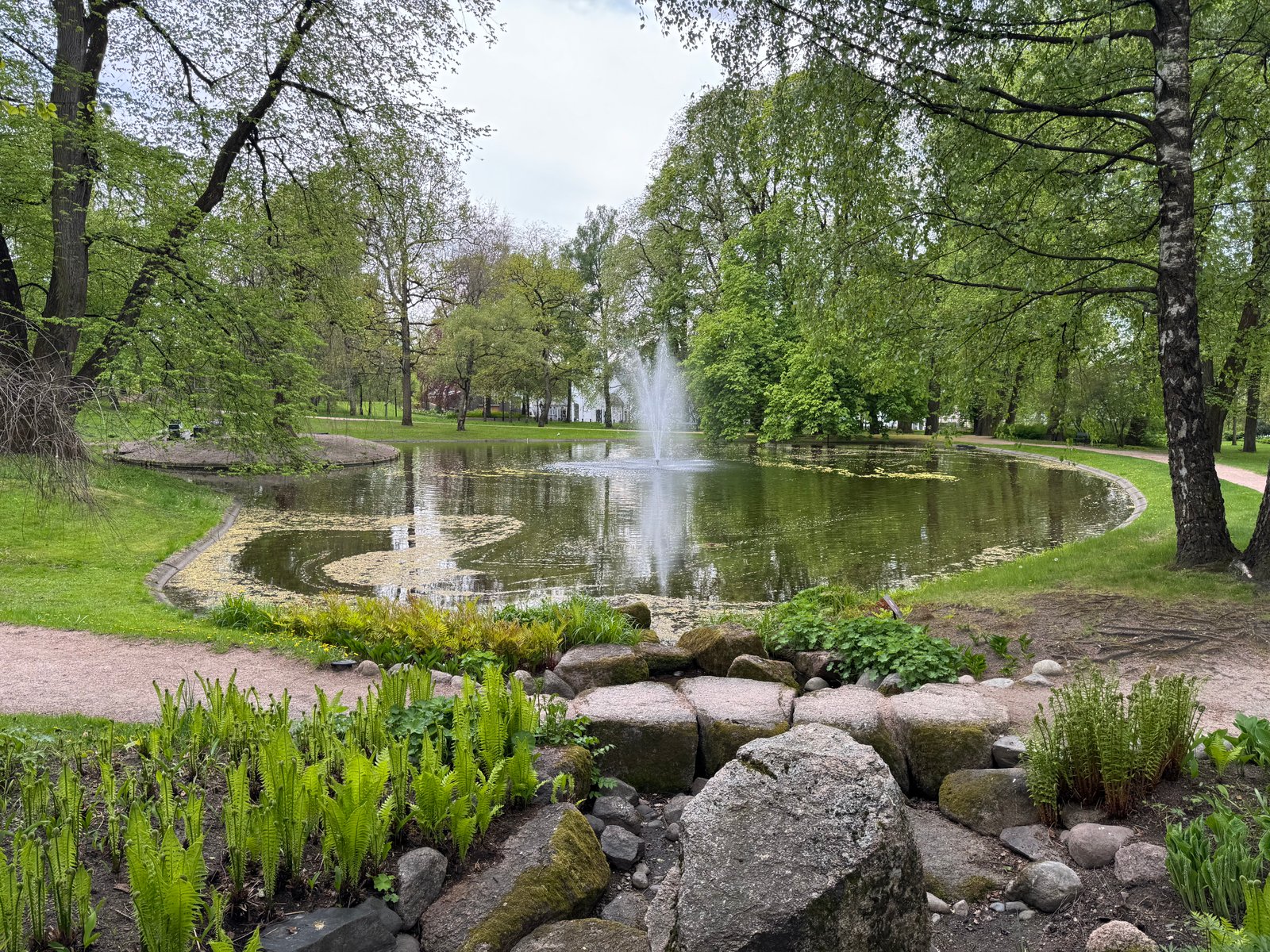
Two small ponds sit behind the palace, connected by a stream. They're called Dronningdammen (the Queen's Pond) and Kongespeilet (the King's Mirror). Ducks gather here, and occasionally a heron. The edges of the ponds make for a quiet rest stop, especially on weekday mornings when the park is mostly empty.
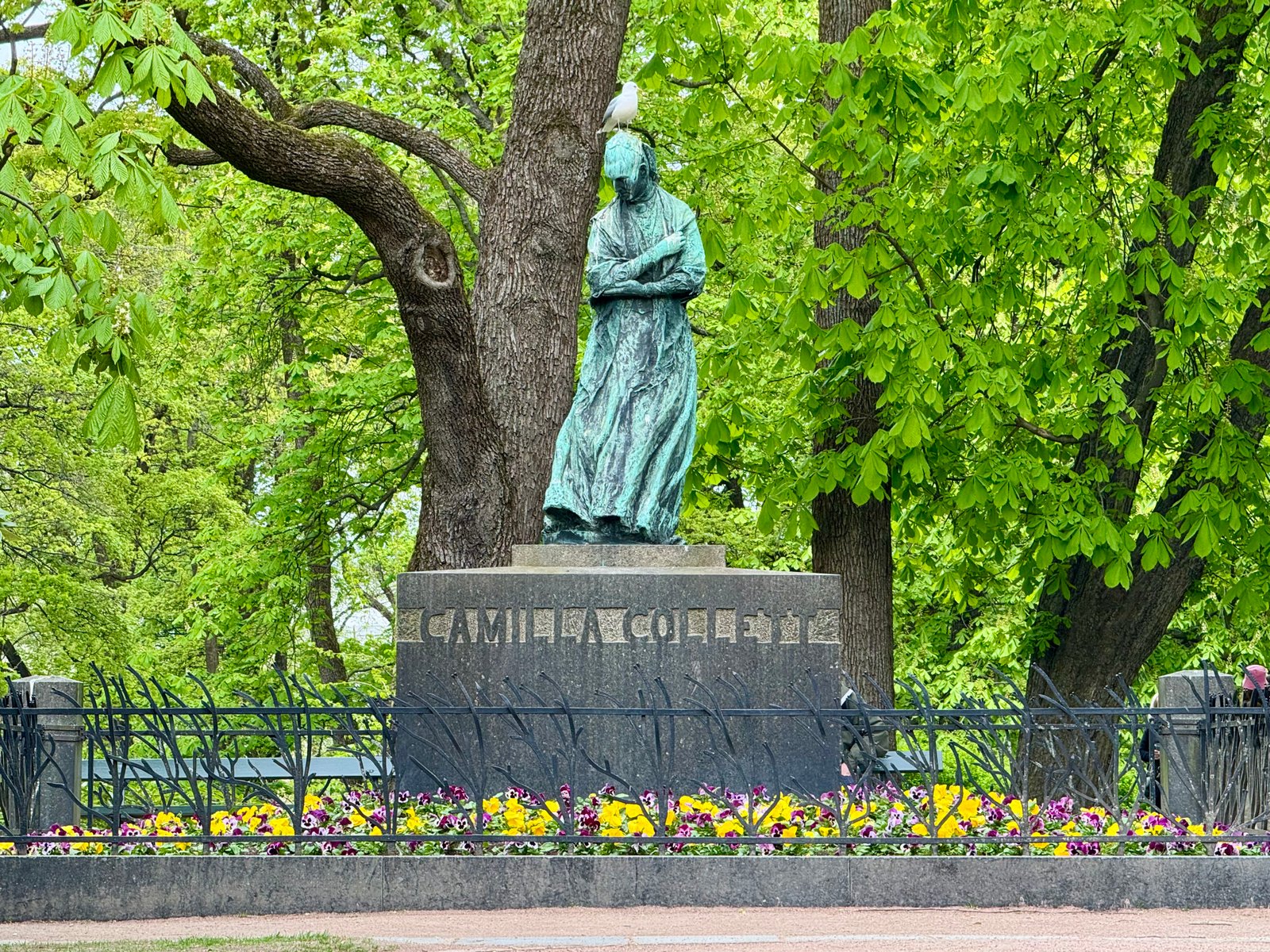
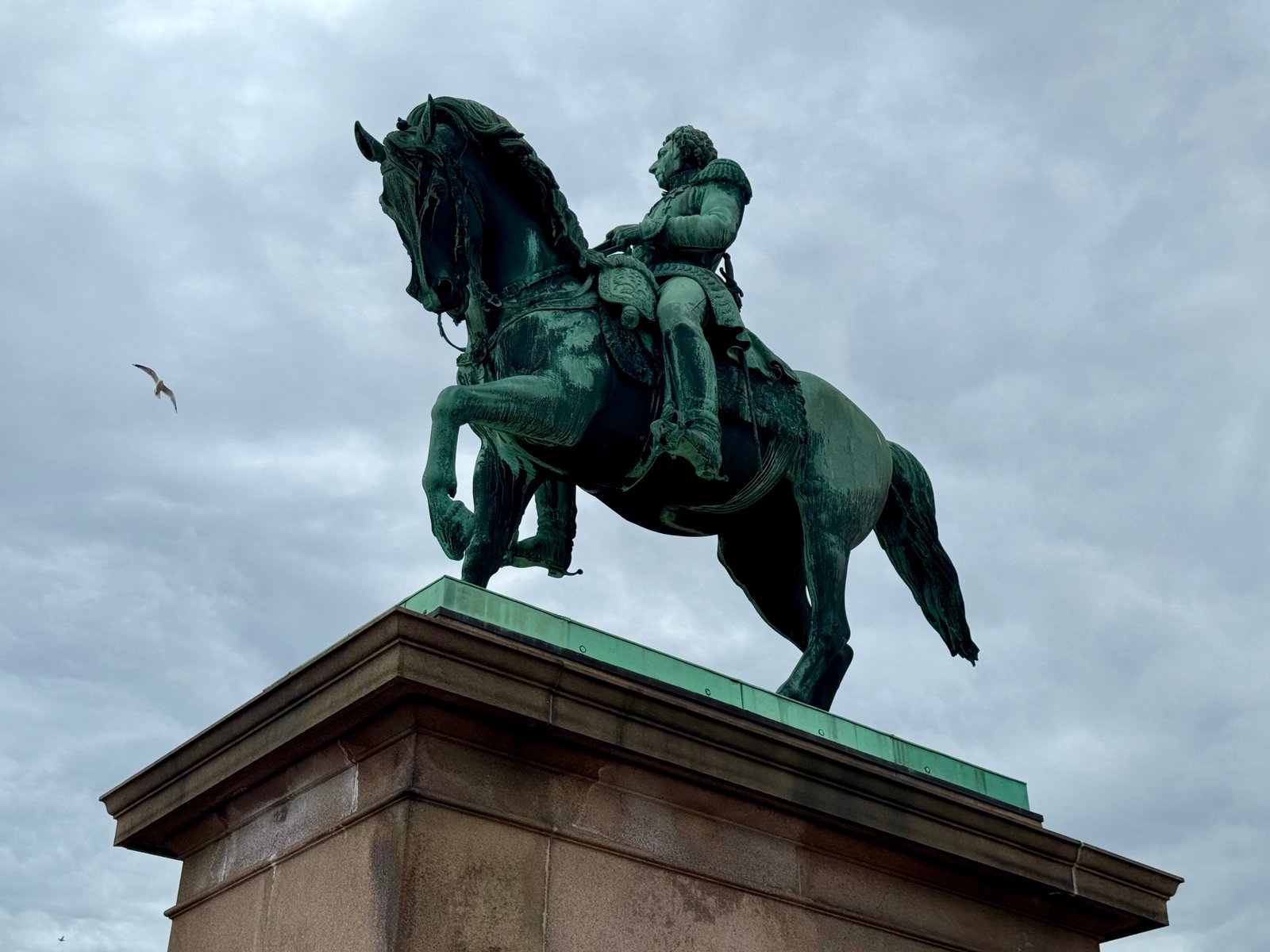
The park holds seven formal statues. The oldest is the equestrian statue of King Carl Johan on Slottsplassen, dating from 1875 and looking straight down Karl Johans gate. Behind the palace, you'll find the statue of Queen Sonja by the King's Mirror, a gift from the Norwegian Trekking Association for her 80th birthday, depicting her as a hiker sitting on a stone with her rucksack beside her. It's a very Norwegian royal portrait. Statues of Queen Maud, Crown Princess Märtha, the mathematician Nils Henrik Abel, and the writer Camilla Collett (both by Gustav Vigeland) are scattered through the grounds.
Princess Ingrid Alexandra's sculpture park
This is easy to miss. Tucked into a section of the main park, the Princess Ingrid Alexandra Sculpture Park contains 12 sculptures designed entirely by children. The project came from a nationwide competition among 5th and 6th graders, and professional craft companies turned the winning drawings into full-size bronze and mixed-media sculptures. The results are strange and wonderful: a rabbit in trouble, a faceless man, a creature called "Mouthlegs," a giant worm, and a running pencil, among others.
King Harald opened the park in 2016 and told the assembled children that the sculptures were "here for you to touch and play with, and not just for decoration." Kids climb all over them. The whole thing feels completely different from any other sculpture collection in the city, and it's the kind of detail that most travel guides completely skip.
Dronningparken (the Queen's Garden)
On the south side of the palace, facing Drammensveien, a gated section of the park is fenced off from the main grounds. This is Dronningparken, the Queen's Garden, and it's older than the rest of the park by nearly a century. The area dates back to 1751, when it was laid out as a private rococo garden on land known as Sommerro. It was folded into the larger Palace Park in 1840, but it has always been kept separate, more intimate and more carefully cultivated than the surrounding grounds.
Dronningparken is open to the public from 18 May to 1 October, daily between 07:00 and 20:00. Outside those dates, the gates are locked. Many visitors walk right past without realising it's there.
The garden is smaller, quieter, and more structured than Slottsparken. Where the main park has broad lawns and mature trees, Dronningparken has rose beds, perennial borders, and neatly labelled plantings. When the roses hit their peak in midsummer, you can smell them from the path before you even see them. There's a gazebo surrounded by flowers, and the whole space has a sheltered, private quality that feels nothing like the open expanses on the other side of the palace.
If you have any interest in gardens, linger here. The plant labelling is thorough, and some of the rose cultivars are old varieties you won't find in most public gardens. It's also noticeably less visited than the main park, even in high season. The benches are usually free, and on warm afternoons it's one of the more peaceful spots in central Oslo.
The best time to visit Dronningparken is late June or early July, when the roses are blooming and the garden is at its most colourful. By September the flowering has faded, and you're mostly walking through greenery. The garden closes for winter on 1 October, so late-season visitors will find the gates shut.
Seasons
Summer (late June to mid-August): The only window for interior tours. Dronningparken is open and the roses are blooming. The park is at its busiest. Book palace tour tickets well in advance.
Late May and September: The Queens Garden is open (18 May to 1 October) but the palace interior is closed. The park is less crowded and still green. Flowers start to bloom early May. A good compromise if you don't care about going inside.
Autumn: The linden avenues turn gold and the park photographs beautifully. The palace is closed and the Queens Garden shuts on 1 October. Still worth a walk through Slottsparken for the colours.
Winter: The palace and the Queens Garden are closed. The main park stays open. The guard change still happens daily at 13:30 but without the summer marching band, it's even more understated.
What to do nearby

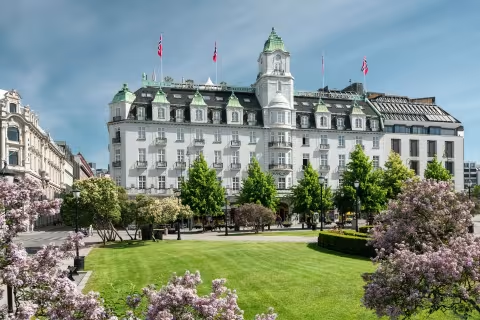
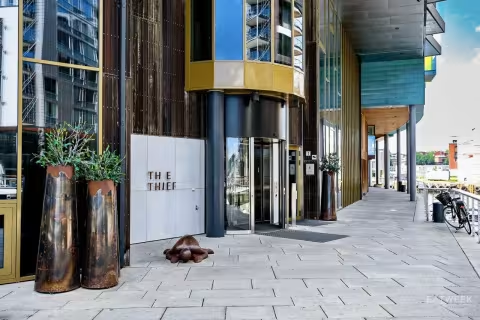
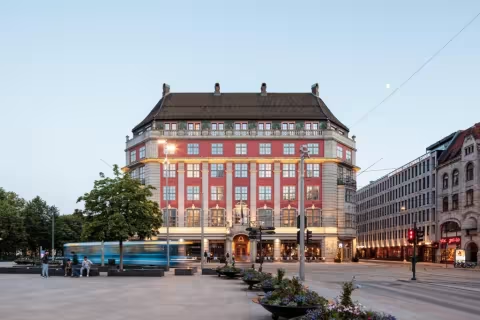
Hotels nearby