By: Chris ⎜ Last updated
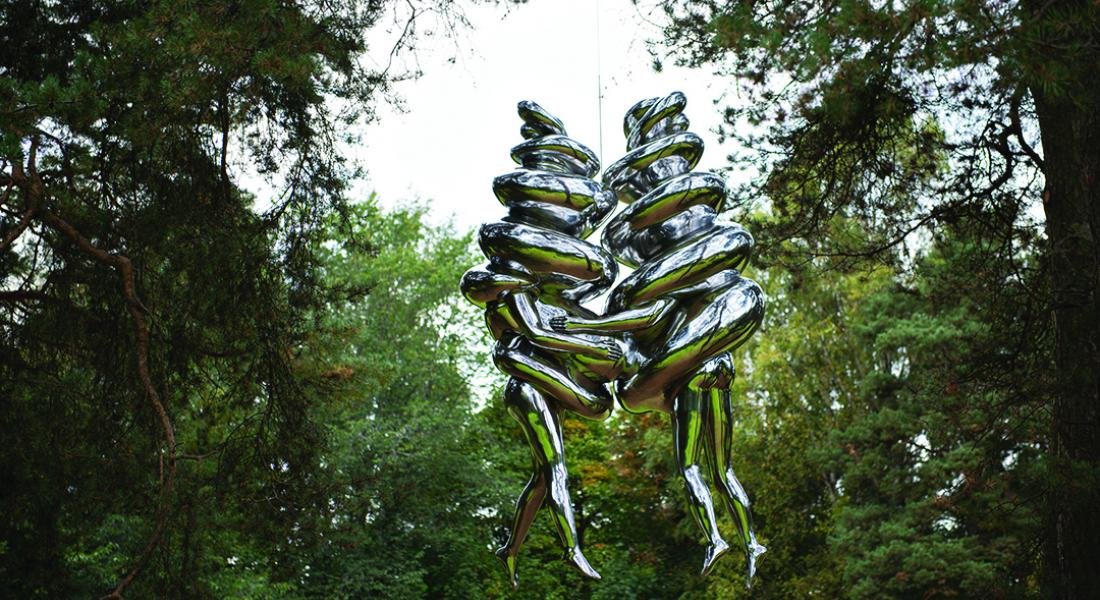
A forested hillside above the Oslofjord with over 40 sculptures scattered through it. Free to enter, open 24 hours, every day, all year. The park exists because of one Norwegian billionaire art collector, Christian Ringnes, who decided to fill a public forest with world-class art and hand the keys to the city. The collection is deliberately eclectic, frequently provocative, and set against one of the best panoramic views in Oslo.
What to expect
Forget any image of a manicured sculpture garden with neat paths and plaques. Ekebergparken is a steep, wooded hillside where art appears behind trees, in clearings, hung from branches, and buried underground. There's no set route and no suggested order. The main gravel loop is well-maintained and covers many of the major pieces, but roughly half the collection sits on forest paths that branch off into the trees. You'll round a corner and find a giant mirrored sphere reflecting the pines back at you, or stumble on a cave filled with flickering video screens and noise.
The view alone would justify the tram ride up here. From several points along the ridge, the whole of central Oslo spreads out below: the angular white roof of the Opera House, the Barcode buildings of Bjørvika, the islands dotting the inner fjord. On a clear evening, the light across the water is extraordinary.
Some of the art is confrontational. The Chapman brothers' Sturm und Dang is a pile of skeletons and burnt flesh. McCarthy's Santa is exactly as provocative as that sounds. Ann-Sofi Sidén's self-portrait involves a timed water jet. None of this is signposted with content warnings, so if you're visiting with children or with someone who prefers their art conventional, know that the park doesn't filter itself. The range lands somewhere between thought-provoking and beautiful, but the occasional shock is part of the design.
Sculptures to see
The full collection is listed on the official artwork page with locations, and each sculpture in the park has a QR code linking to background information. Between the QR codes and the park map (pick up a paper copy at the museum in Lund's Hus), the park works well as a self-guided visit.
The pieces that consistently catch people off guard are Tony Oursler's installations, and there are three of them. Spectral Power is a streetlamp on a forest path that starts talking as you walk past, flickering and murmuring in a voice that blends poetry with digital noise. It's unsettling in the best way, especially at dusk. Klang is harder to find, tucked into a stone cave further up the hill. Step inside and you're surrounded by screens projecting symbols, runes, and frantic images, all overlapping with sound. Cognitive/Dissonance projects shifting images directly onto the tree canopy above a clearing.
The Dalí, Rodin, and Botero along the main gravel loop are the pieces most visitors photograph first, as recognisable names in a forest setting. They're worth pausing at, but the real discoveries are further off the path. If you only walk the gravel, you'll see maybe half of what's here.
Nordic Pixel Forest
Pipilotti Rist's Nordic Pixel Forest opened in September 2024 and is now a permanent installation, the 46th artwork in the collection and the park's biggest single project since it opened in 2013. Thousands of LED lights are threaded through the branches of a section of forest, shifting colour and pattern in response to the weather, the time of day, and the movement of people walking through.
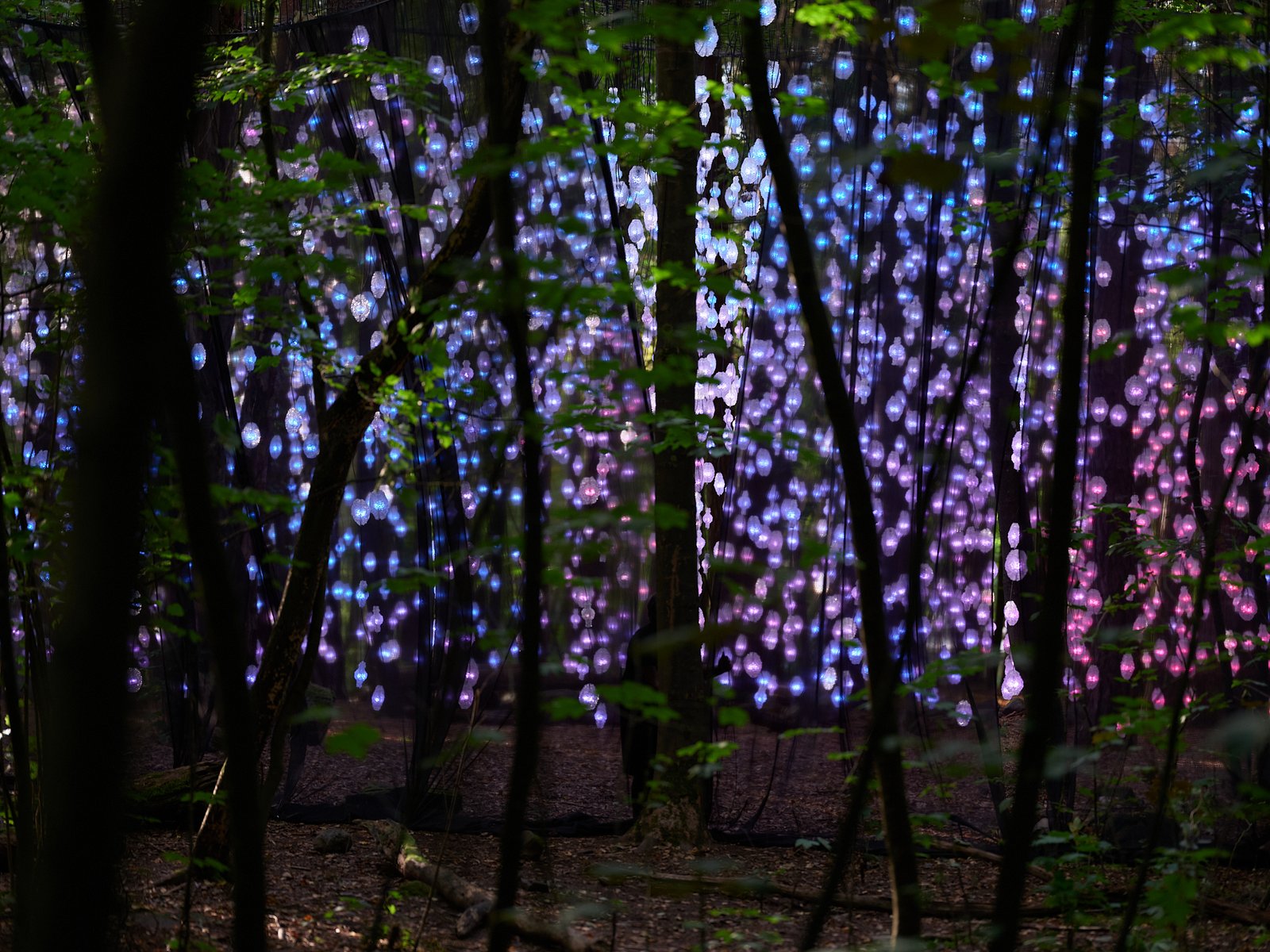
During daylight, you'll notice the hardware but not much else. After dark, it transforms. The LEDs turn the forest canopy into a slowly breathing, colour-shifting ceiling. In winter, when it's dark by mid-afternoon, you can catch it on a normal visit. In summer, you'll need to stay late, which is the single best reason to come here before sunset: arrive in the afternoon for the sculptures and views, head to the Pixel Forest as the sun sets.
As long as you visit at the right time this is likely the single best artwork in the park, while in broad daylight you're just looking at hanging lightbulbs.
James Turrell's underground installations
Two light installations occupy a converted water reservoir in the middle of the park. Ganzfeld: Double Vision fills a room with coloured light so uniform that walls, floor, and ceiling dissolve. Depth perception stops working. You can't tell where the room ends. It's disorienting in a way that's hard to convey until you're standing in it. Skyspace: The Color Beneath is a circular chamber with an opening cut into the ceiling, framing a rectangle of sky. Coloured light inside the room shifts to alter how you perceive the sky above. During sunrise and sunset sessions, the effect is at its strongest.
Free guided entry runs every Sunday, 11:00–16:00, year-round. Tours leave roughly every 30 minutes, take about 20 minutes, and hold a maximum of 8 people. There's no pre-booking. You show up, find the guide by the entrance near the water pond in the centre of the park (marked on the park map), and check the blackboard for available slots. If the next tour is full, the guide can reserve you a spot on a later one.
Slots fill fast at the start of the day. The park recommends arriving just before 11:00 if you want to guarantee a place. There's a break from 13:30 to 14:00. Children under 10 must be accompanied by an adult, one adult per child, and you can only enter with a guided tour.
Sunday is the only day to see the Turrell installations without a private booking. On any other day, you'll need to arrange a private group visit. If your Oslo itinerary doesn't include a Sunday, factor this in or accept that you'll miss them.
The Munch Scream viewpoint
The stretch of hillside where Munch experienced the moment that became The Scream is right here on Ekeberg. The park has a marked Munch Spot on its map with a large photo frame installation at the viewpoint, looking out across the fjord toward the city. The panorama matches the painting's background, the curve of the shoreline, the sky above the water. At sunset, the connection is obvious.
The viewpoint is along the western edge of the park, not deep in the forest. If you enter from the Ekebergparken tram stop at the bottom, follow the main path uphill and look for the marked viewpoint on the park map.
Inside the museum in Lund's Hus, Marina Abramović's film The Scream plays on a loop. She had Oslo residents stand at the same viewpoint and scream their emotions out over the fjord. It's short, surprisingly intense, and free to watch during museum hours (11:00–16:00 daily).
Planning your visit
The main gravel loop with a few detours and a coffee stop takes about 90 minutes. Three hours covers the forest paths, the Pixel Forest, the Munch viewpoint, and a meal. If you're timing for a Sunday Turrell visit, add another 30–45 minutes including the wait.
The best time of day, in any season, is late afternoon into evening. The sculptures and views work in daylight; the Pixel Forest and Oursler's light pieces come alive after dark. Arriving two to three hours before sunset and staying through twilight gives you both. In midsummer, that means arriving around 19:00 and staying until 22:00 or later. In winter, arriving at 13:00 or 14:00 works, because the dark does the rest.
Late spring through early autumn is the most comfortable season. The Ekebergrestauranten terrace opens for summer, the forest is green, and the paths are dry. But the park in winter has its own pull. The Pixel Forest in snow draws crowds, and the low winter light changes the mood of the sculptures entirely. Be warned, though: the steep paths get icy, and the exposed sections can be slippery.
Midday in summer is the worst time to visit. No shade on the exposed viewpoint sections, the light installations aren't visible and the lighting for photographs is rather hard.
Where to eat
Ekebergrestauranten sits at the western edge of the park in a 1920s functionalist building. The reason to eat here is the terrace. In summer, with the Oslofjord spread out below and the Opera House roof catching the light, it's one of the better restaurant views in Oslo. The terrace menu is more casual than the indoor dining room: wood-fired pizza, focaccia, lighter dishes. The indoor set menu leans fine dining with prices to match. It's just a shame that the view outperforms the food. The cooking is competent, sometimes very good, but service can be uneven and the pricing reflects the location. Book ahead for a terrace table in summer, especially on weekends.
Karlsborg Spiseforretning is the less formal alternative. A café in an 1863 villa at the edge of the park, serving sandwiches, soups, salads, and pastries from French-trained bakers. No reservation needed for the café. Open Thursday to Sunday, 12:00–17:00. Afternoon tea on Saturdays (book ahead for that). The food is simple, well-made, and a fraction of the Ekebergrestauranten prices. You can take it out onto the veranda or carry it into the park.
The museum café in Lund's Hus does coffee, snacks, and ice cream. Functional rather than a destination, but it's there if you need a quick stop.
Practical details
Toilets: The white building opposite Karlsborg has public toilets for a small entrance fee. The museum in Lund's Hus has an accessible toilet during opening hours (11:00–16:00).
Accessibility: The main gravel loop is the most accessible route and covers many of the major sculptures. Forest paths are uneven, unpaved, and not wheelchair-accessible. The park is on a steep hill overall. The museum has a lift and an inclined plane at the entrance.
Ekebergparken vs. the Vigeland Park
You might be asking yourself, should you do both parks? If you have time, the answer is a clear yes. They complement each other well. These parks are not really alternatives, the are complete opposites. The Vigeland Park is a symmetrical, single-artist park on flat ground in the west of the city. Everything is laid out for you. Ekebergparken is a multi-artist forest on a steep hill in the east, with no set route and half the sculptures hidden off the main path. Vigeland has more tourists, more structure and more famous sculptures. Ekebergparken has more solitude and more surprise.
Most visitors do Vigeland first because it's on the standard tourist circuit and easier to navigate. Ekebergparken rewards the extra tram ride with a completely different atmosphere, better views, and an experience that feels more like discovery than sightseeing.
What to do nearby
Hotels nearby