By: Chris ⎜ Last updated
Why should you take the Ulriksbanen up Ulriken? Every Bergen visitor ends up considering between Fløyen and Ulriken. Fløyen is by far the easiest one to access, with the funicular leaving from the city centre, and the ride taking only four minutes. Unfortunately it's also where every cruise ship passenger goes, and it shows.
Ulriken is higher (643m to Fløyen's 320m) and far less visited. The cable car station is a short trip outside the city centre, which ensures the casual crowd stays away.
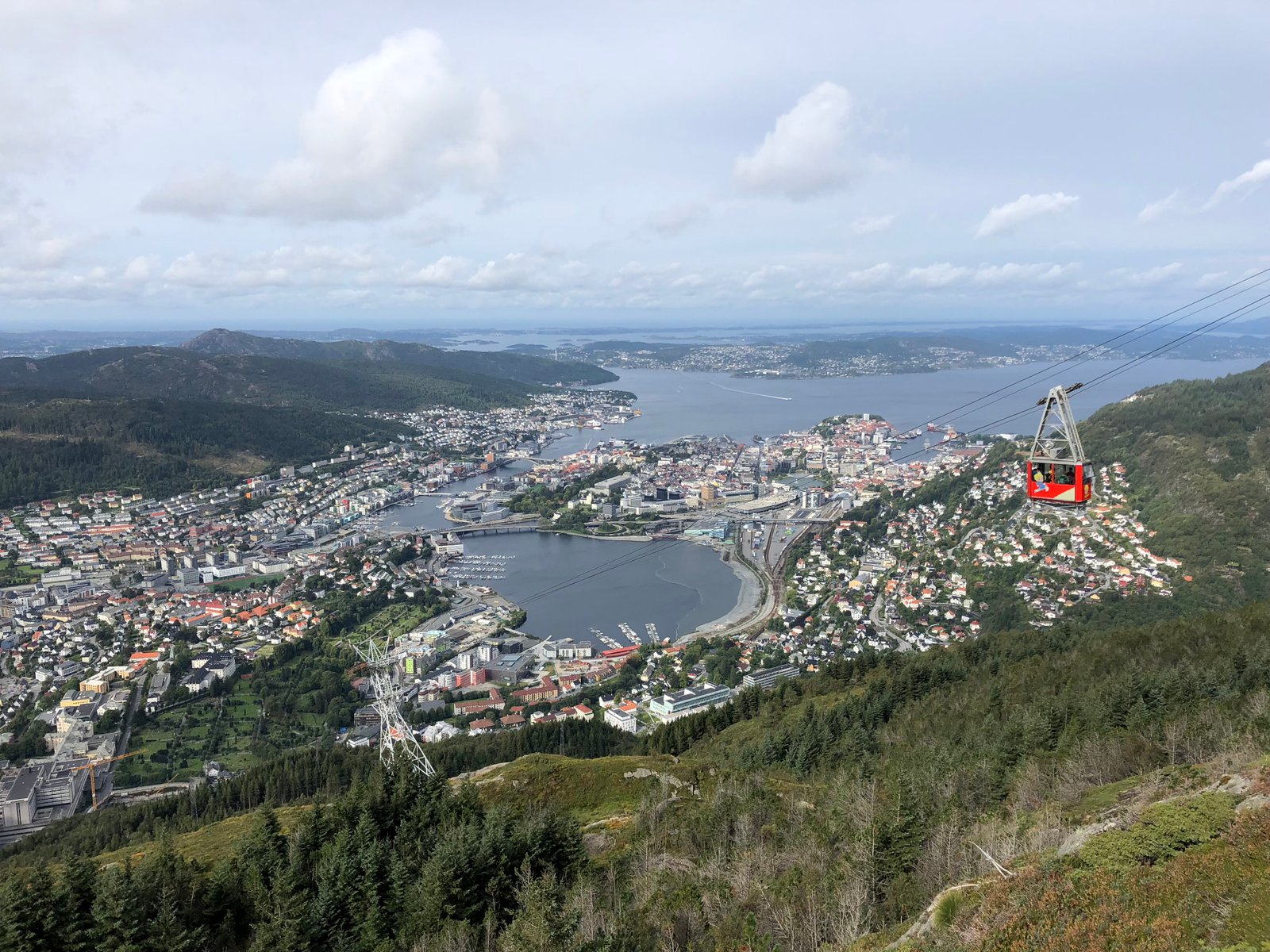
At the top, you're above the treeline on an open mountain plateau with views in several directions. You have the city, fjords and islands below you, and on clear days you can see the Folgefonna glacier to the south. Fløyen gives you a nice view of Bergen, while Ulriken gives you a view of the entire region.
If you only have an hour or so, Fløyen is the logical choice. If you have a half day or more, Ulriken is the better experience. And if you're fit enough for a proper hike, the Vidden trail connects Fløyen to Ulriken across the mountain plateau, which means you don't have to choose at all.
Arguably, only taking the gondola up and down again might not be worth it. In our opinion the better experience is hiking up the Sherpa stone steps (read more below), then you've really earned the return by cable car down.
Getting there
The cable car's lower station is a few kilometres south of the city centre. It's not walkable from Bryggen, but easy to reach two ways.
The Ulriken Express bus is the simplest option if it's running. From April through mid-October, a dedicated shuttle leaves from Torgallmenningen (right by the Tourist Information, near the Fish Market) every 30 minutes, the ride takes 10–15 minutes and drops you at the cable car entrance. You buy your ticket when you board.
Bybanen Line 2 (Bergen's light rail) runs year-round and is the cheapest option, especially if you have a Bergen Card covering public transport. Get off at Haukeland Sykehus, and from there it's a 10-minute walk uphill to the lower station, either via the road with switchbacks, or through the Glassblokkene hospital campus where there are stairs.
Visibility
This is the most important piece of advice in this article. Bergen's cloud layer often sits low, which can mean zero visibility on Ulriken. The cable car will still run (it only closes in high wind) though. Check the Ulriken webcam before you buy your tickets. If the webcam shows a view, go. If it shows a wall of grey, try again another day instead.
At the top
The cable car ride itself takes about five minutes in a modern, glass-walled gondola. The gondolas were replaced in 2021 and are fully wheelchair and stroller accessible.
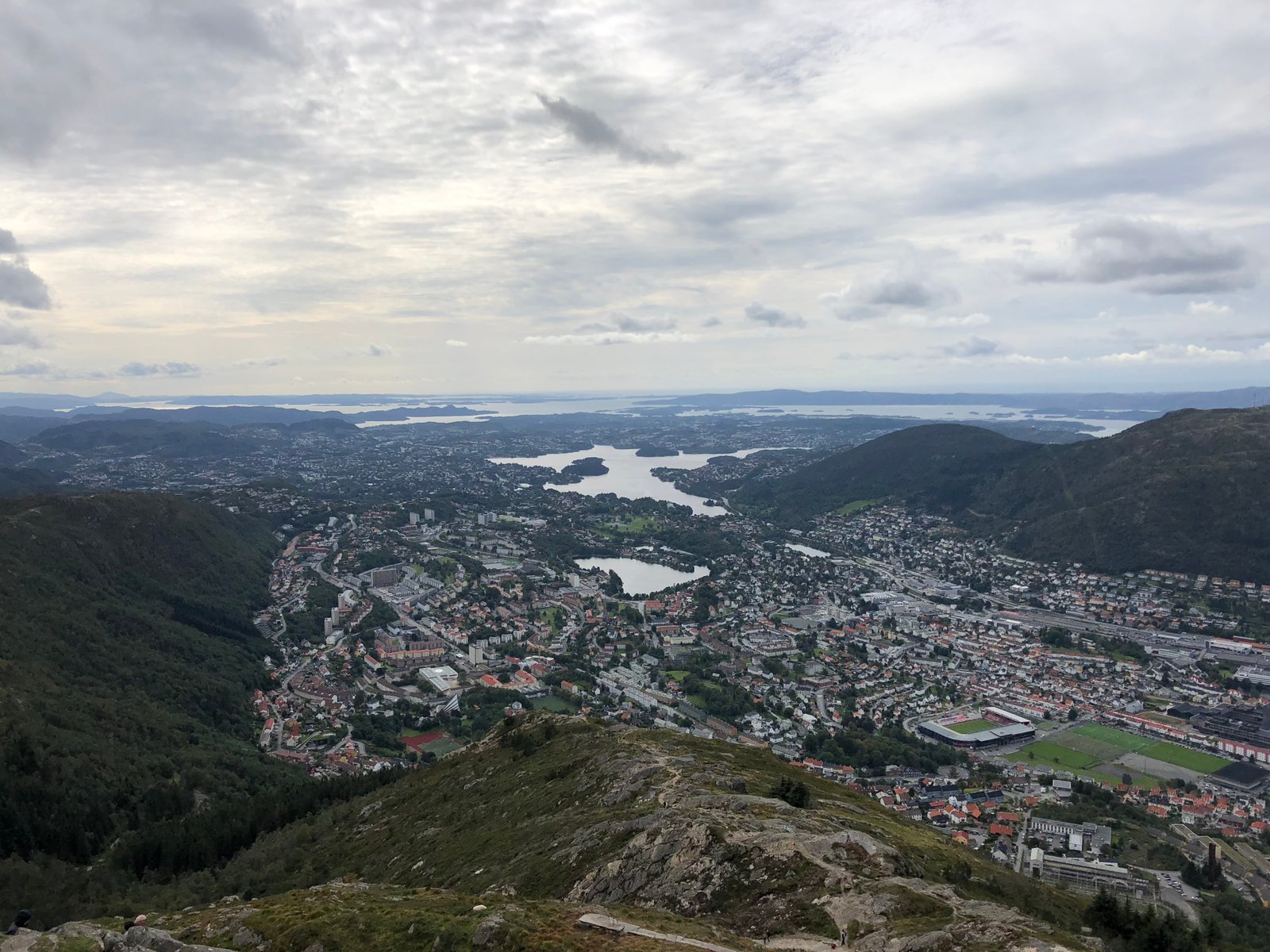
At the top, you will find a paved plateau with a viewing terrace. On a clear day, the view covers Bergen below, the archipelago, the fjord system, and the mountain ranges behind. On the clearest days, the Folgefonna glacier is visible to the south.
The wind can be strong on top. Ulriken is exposed to the North Sea with nothing to break the airflow. Even on a warm summer day in Bergen, the temperature at the top will drop a few degrees, and the wind chill makes it feel colder still. Make sure you bring a proper windbreaker, not just a thin hoodie.
Take your time at the top. Don't just take the cable car up, snap a photo, and ride straight back down. Those will be some rather expensive photos. The plateau, the lakes, the panorama trail, and especially the Sherpa steps are where Ulriken separates itself from Fløyen. Budget at least 60 minutes at the top, more if you're hiking further inland.
The panorama trail to the summit
The cable car station isn't quite at the peak. A marked trail (Ulriksvarden, about 45 minutes return) takes you to the actual summit at 643m. The hike is easy and well-marked, and is worth doing for the slightly different views and just for standing on the highest point of Bergen's seven mountains.
The zipline
The zipline is billed as the fastest zipline in Norway, but it's fairly short at only 300 metres long, and the ride lasts around 30 seconds. The experience divides people sharply. If you've done ziplines elsewhere, this one is short and not very thrilling for the price. It is not a reason to go to Ulriken, but it's a reasonable add-on if the conditions are right and you're curious.
Eating
There are three rather different options at the top.
Ulriken Kafé is the drop-in option, where no reservation is needed. Here you get hamburgers from the grill, hot dogs, fish soup, baked goods, the house-made "Ulriken bun," coffee, beer, ice cream. It's at the entrance to the main building and opens at 9am (full kitchen from 11am). On clear-weather days the café fills up fast.
The food is OK but nothing memorable, it's the location that's the draw, not the kitchen.
Skyskraperen Restaurant is different, being a proper sit-down restaurant with seasonal menus built around local ingredients, a 3-course lunch and a 5-course dinner, both with the cable car ticket included in the package price. Reservations are required (booking@skyskraperen.no).
The service is consistent. Staff explain each course, pace things well, and treat you like you've got nowhere else to be. The winter menu received a 5 out of 6 from Bergens Tidende's food critic, so the kitchen is clearly capable. They even smoke their own meats on the mountaintop.
The sunset dinner is the best experience. The dining room has large windows, and watching the light change over Bergen and the fjords while eating a five-course meal justifies the cost.
Hiking up and/or down: the Sherpa steps
The Oppstemten is the most popular walking route to the top of Ulriken, and it's a serious workout. The name comes from Norwegian "opp" meaning "up" and Stemten which is the old name of the trail up the mountain. Here you are climbing up about 1,300 stone steps built by Nepalese Sherpas, the trail rising 750 metres along the mountainside in a near-continuous staircase.
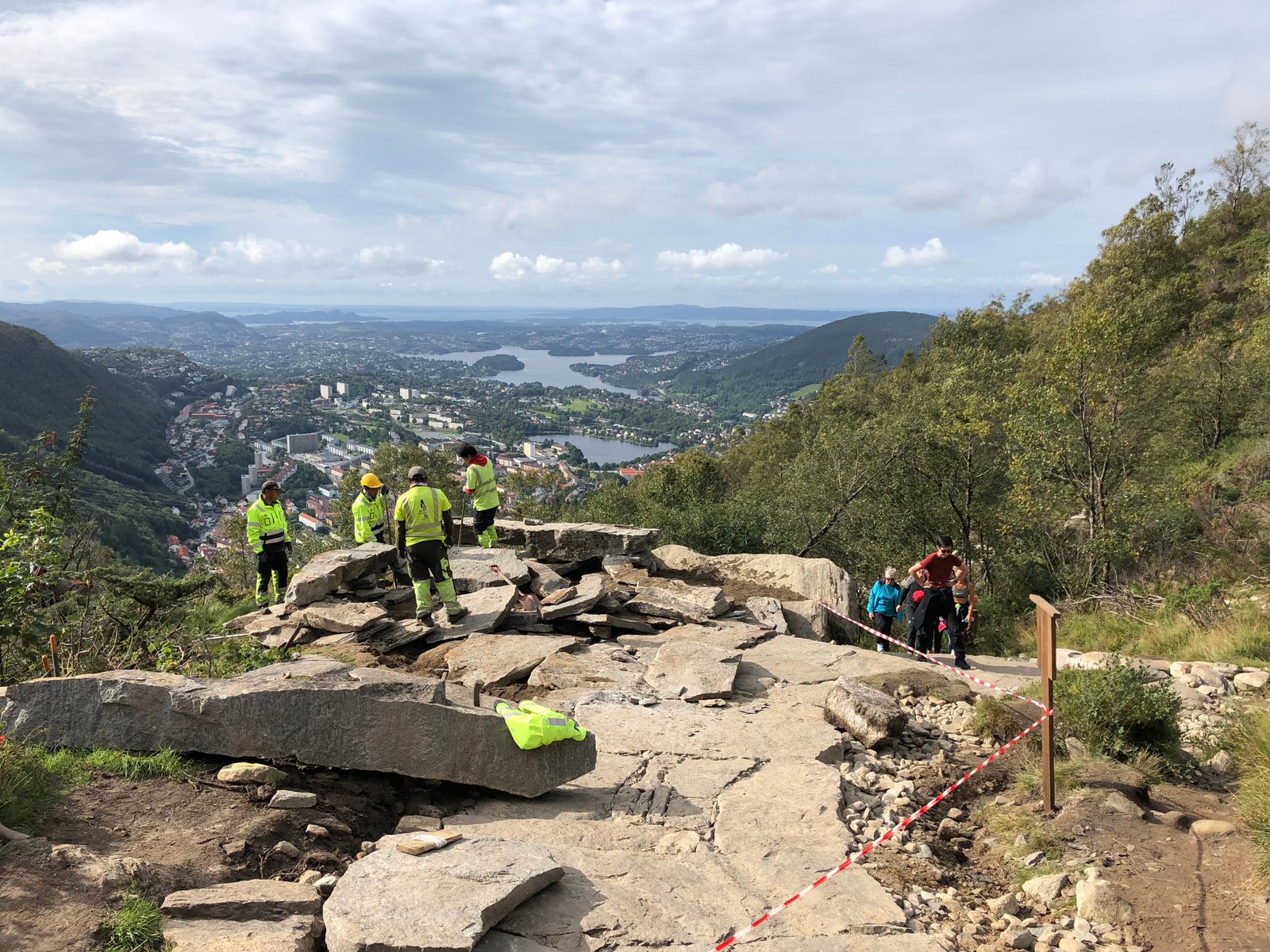
The starting point is Montana, a short walk from the Ulriken cable car station.
How long it takes depends entirely on fitness. Regular exercisers finish in about an hour. Local trail runners do it in 40 minutes, and you might see them blowing past you with headphones. Families taking their time should budget two hours. The steps have built-in rest benches and viewpoints at intervals, and there's absolutely no shame in stopping. Take your time, pace yourself, and it's doable for anyone in reasonable shape.
The steps themselves are well-built and solid, but Bergen's climate means they're often wet. In rain or after rain (which is most of the time), the stone gets slippery. Proper hiking shoes with good grip are a good idea.
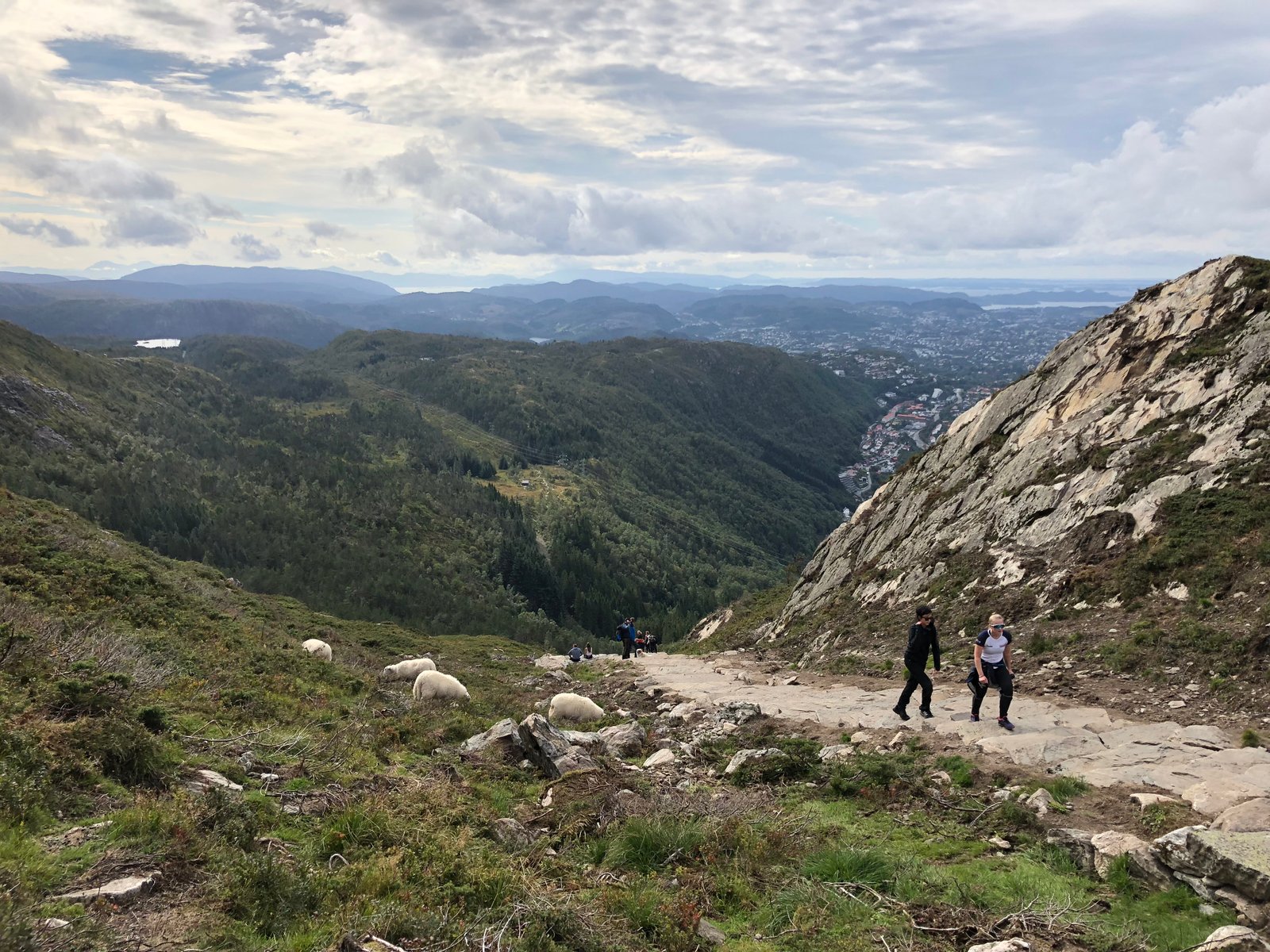
Steps up - Ulriksbanen down
The smartest combination is hiking up the Sherpa steps and taking the cable car down. You earn the view, save your knees on the descent, and a one-way cable car ticket costs less than a return. If you'd rather do the opposite, the cable car up and walking down works too.
The Vidden trail to Fløyen
The Vidden trail crosses the mountain plateau between Ulriken (643m) and Fløyen (320m), connecting the two most prominent of Bergen's seven mountains across a roughly 13–15 kilometre trail. Expect this to take 5–6 hours for the full crossing, while strong hikers can do it in 4.
The most popular direction is Ulriken to Fløyen, and for a good reason: you are walking down from the highest to the lowest mountain, and you finish the hike at Fløyen, where you can take the funicular straight down into the city centre, and walk back to your hotel within minutes.
The word "trail" suggests a gentle path, but what you get is rocky ground, significant ups and downs and some boggy sections (especially in the middle stretch). The trail is well-marked with stone cairns and wooden poles.
You're above 500m for most of the hike. The views, when the weather cooperates, are extraordinary with Bergen and the sea to the west, mountains to the east, and the fjords in both directions. Storhaugen (662m) is a short detour off the main trail and worth the extra 10 minutes for the highest vantage point on the route, with views south to the Folgefonna glacier.
The route passes mountain lakes, streams, and high plateau landscapes that feels remote despite being directly above a city of 280,000 people, and you'll share the trail mainly with local hikers and trail runners, not tourists.
Practical details for the Vidden
What to bring: Water (refill at the Ulriken cable car station or Fløyen, because there's nothing in between), enough food for a full day, windproof layers, proper hiking shoes with ankle support and good grip, and a downloaded offline trail map on your phone (AllTrails or the UT.no app both cover the route). Mobile signal can be patchy.
Brushytten cabin sits near the Fløyen end of the trail and serves Norwegian waffles on Sundays, 11:00–16:00, year-round. It's the last food and drink opportunity before the funicular. On a Sunday, it's a good treat after hours hiking on the plateau. On other days, the cabin may be closed.
The mud between roughly the midpoint and the approach to Fløyen can be significant, especially in shoulder season or after rain. During fall, the trail might turn into a muddy slog in the second half. Don't go between October and April unless you are an experienced hiker.
The visitBergen Vidden guide has route details and a downloadable digital map.
When to go
May through September is the best period. This is when the cable car runs its full summer schedule, the Ulriken Express bus operates, the zipline is open, the Vidden trail is in season, and daylight lasts well past 22:00 in June and July. Come up here on a late summer evening and you will have a better experience.
Bergen averages 240 rain days per year. A clear day on Ulriken is not guaranteed and cannot be planned weeks in advance. If you have multiple days in the city, keep your schedule flexible and go when you have clear skies or high clouds. The webcam is your best tool for a same-day decision.
In winter (October through March), the cable car runs on a reduced schedule. It's closed Mondays with shorter hours on other days (closes at 19:00 Tuesday/Wednesday/Sunday, 23:00 Thursday–Saturday). The Sherpa steps can be icy and dangerous, and the Vidden trail requires winter experience and equipment. The best thing to do during winter is to take the cable car up and eat dinner at Skyskraperen while watching the city lights below. Check the official opening hours before planning a winter visit.
The Bergen Card gives a 10% discount on cable car tickets and it covers the Bybanen ticket to get to get to the lower station. The Ulriken Express bus is not covered by the Bergen Card.
What to do nearby
Hotels nearby