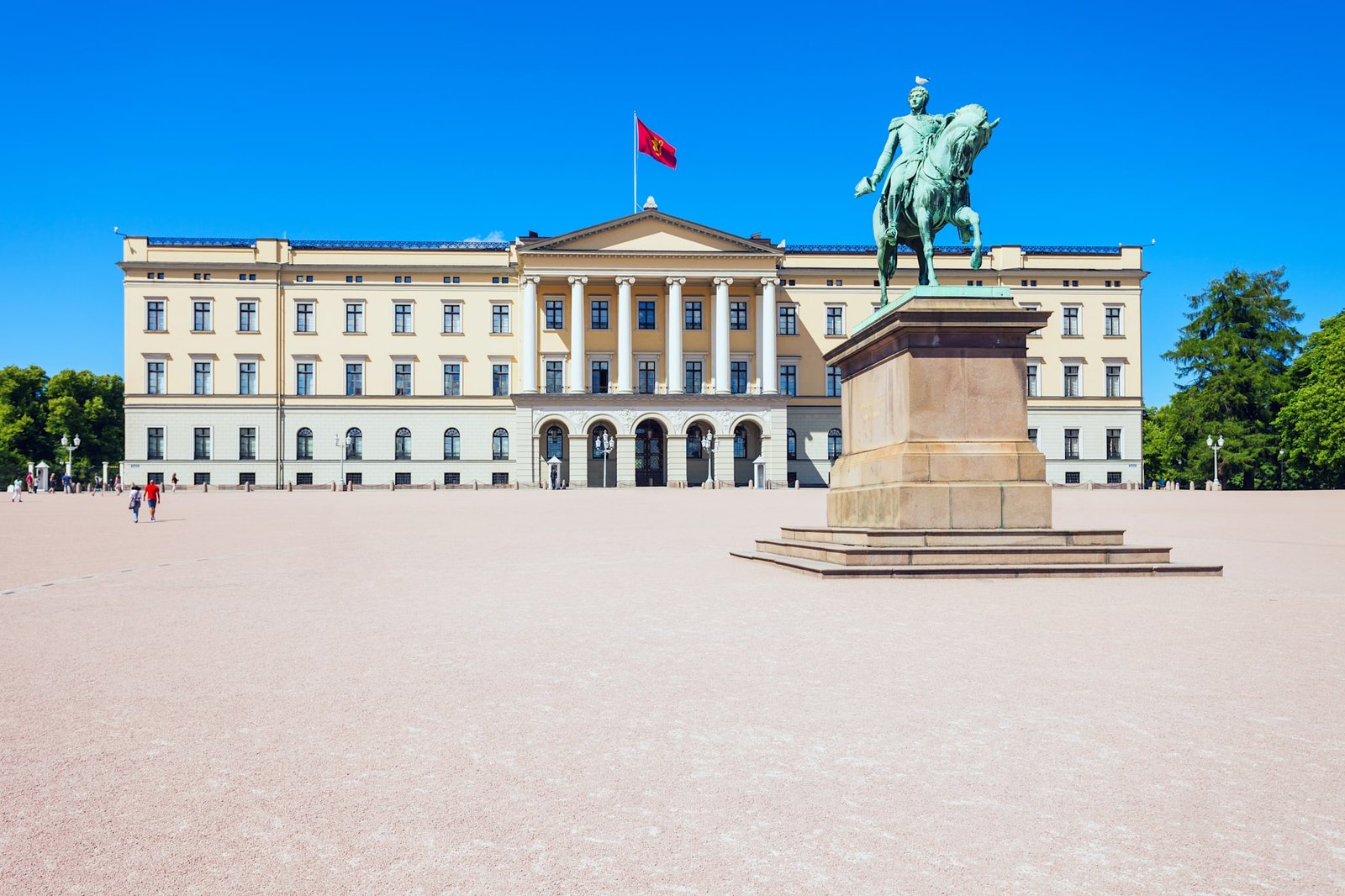
This Neoclassical building completed in 1849 sits at the top of Karl Johans gate, Oslo's main thoroughfare, functioning as the working residence and office of King Harald V and Queen Sonja. The King holds the Council of State here, grants audiences, and hosts official dinners. Unlike gated European palaces, this one sits surrounded by Slottsparken, a massive public park that locals use as a thoroughfare, picnic spot, and outdoor living room year-round.
The Royal Guards (Hans Majestet Kongens Garde) perform the Changing of the Guard daily at 1:30pm sharp, 365 days a year. Summer ceremonies may include a full parade with music corps marching from Akershus Fortress (40 minutes). Winter or standard days feature a simpler but still precise military ritual. Stand by the low fence in Slottsplassen (the main square) for clear views.
The palace interior opens to the public only during summer (typically late June to mid-August). You must join a 60-minute guided tour booked months in advance through Ticketmaster. Tickets release in March or April and sell out fast. Tours lead through the Cabinet Cloakroom, Council Chamber, White Parlour, Great Hall (ballroom), and Banqueting Hall. The interiors are lavish: Pompeian frescoes, massive chandeliers, and gilt details that contrast sharply with the modest yellow exterior facade. Most tours run in Norwegian. English tours typically happen at 12pm, 2pm, and 4pm (verify current schedule).
Outside summer, the interior is closed but the park remains free and open 24/7. The park holds several features worth visiting: the Princess Ingrid Alexandra Sculpture Park (colorful geometric sculptures designed by schoolchildren that you can climb on), the Queen Sonja Art Stable (Dronning Sonja KunstStall) in the old palace stables at Parkveien (rotating art and history exhibitions from the royal collections, open year-round), and the equestrian statue of King Karl Johan facing down the street named after him. Locals joke he's watching to make sure parliament (Stortinget) behaves.
The palace sits at the end of a straight 1-kilometer axis from Oslo Central Station. The view looking down Karl Johans gate from the palace steps shows the entire city stretching out in a line: the National Theatre, Parliament, the Cathedral, and the station beyond. This perspective is one of Oslo's best urban views and completely free.
Highlights
Best time to go
Time needed
Getting there
What to do nearby
Hotels nearby