Kon Tiki Museum

See and stand underneath the original balsa wood raft that Thor Heyerdahl sailed 8,000 kilometers across the Pacific in 1947 to prove ancient peoples could have crossed oceans

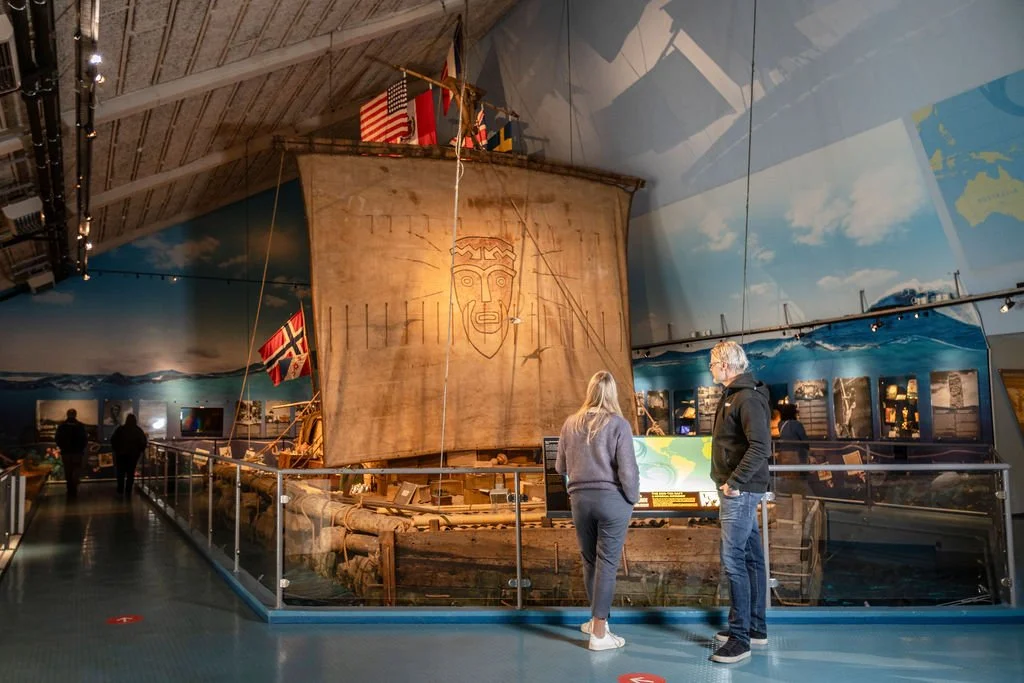
This museum on the Bygdøy peninsula houses the original vessels from Thor Heyerdahl's world-famous expeditions to prove ancient peoples could have crossed oceans on primitive craft. In 1947, Heyerdahl and five others sailed a balsa wood raft (the Kon-Tiki) from Peru to Polynesia across 101 days to prove ancient South Americans could have settled the Pacific Islands. The museum sits right next to the Fram Museum, making them an easy explorer double-feature.

The museum atmosphere is darker and more immersive than typical white-walled galleries, mimicking the feeling of being under Pacific stars or beneath the ocean. The Kon-Tiki raft centerpiece displays the original balsa logs and hemp ropes that held together for 101 days at sea. The Ra II, a vessel made entirely of papyrus reeds, sits nearby. Heyerdahl sailed this across the Atlantic to prove ancient Egyptians could have reached the Americas. The boat is surprisingly large and elegant up close.

The underwater exhibit below the rafts features a "dry" tunnel you walk through with a life-sized model of the massive whale shark that famously swam under the Kon-Tiki during the expedition. The Easter Island (Rapa Nui) collection fills a walk-through "cave" with statues and artifacts (some replicas, some originals) from Heyerdahl's archaeological digs there. He was obsessed with Easter Island theories.

The museum cinema on the lower level screens the Oscar-winning 1950 documentary (filmed by the crew on the raft) daily at 12pm. This gives crucial context to the vessels you're looking at. Logbook excerpts displayed throughout detail terrifying storms and shark encounters in the crew's own words.

Combine with Fram Museum next door using a combo ticket for a 2-3 hour explorer-focused visit to Bygdøy. Arrive via the Bygdøy ferry if weather permits for the scenic fjord approach.


The 12pm documentary is essential. The 1950 film was shot by the actual crew during the 101-day crossing. Watching the actual footage of waves crashing over the raft, then seeing that same vessel intact in front of you, transforms the visit from "looking at old boats" to understanding what these people endured. Skip this and you miss half the point.

Highlights


Stand under the Kon-Tiki raft and examine the balsa logs and hemp ropes up close. The dimly lit hall creates atmosphere but also lets you appreciate how basic the construction was. These materials survived 8,000 kilometers of open ocean.
Enter the Easter Island cave filled with Rapa Nui statues and artifacts. Heyerdahl spent years trying to prove Polynesia was settled from South America. The obsession drove his entire career. This section shows how far beyond ocean crossings his theories went.
Find the Tigris expedition exhibit. Less famous than Kon-Tiki but the story is powerful: Heyerdahl burned this reed ship in Djibouti in 1978 as a protest against wars raging in the Red Sea and Horn of Africa. The political statement gets overlooked by most visitors.


Best time to go


Weekday mornings 10-11:30am, October through April for smallest crowds and time to watch the 12pm documentary. Summer (May-September) brings extended hours and more frequent museum ferry service from City Hall, but also cruise ship groups between 11am-2pm.

Time needed


45–120 minutes

Getting there


Museum ferry from City Hall Pier 3 (Rådhusbrygge 3), 15 minutes, runs March-October, drops you directly at the museum cluster. Bus 30 from Jernbanetorget (central station) year-round, 20 minutes, stops at "Bygdøynes" right at the museum entrance.

What to do nearby


2.1km
See the late-19th-century apartment where Henrik Ibsen lived and worked in his final years, now paired with a small theatre programme that brings his world into performance.
2.1km
See the original full-size plaster casts that became Vigeland Sculpture Park's famous bronzes and granites, and tour the artist's preserved 1943 apartment with custom-designed furniture inside his former studio building.
2.2km
Experience the human story of Norwegian resistance during Nazi occupation (1940-1945) through atmospheric dark-to-light museum design, illegal newspapers hidden in firewood, saboteur equipment concealed in fish barrels, and the Heavy Water Sabotage that stopped Germany's nuclear program

Hotels nearby


2.4km
Free evening meals Monday through Thursday smack in the middle of Oslo
2.5km Insider pick
A Michelin-starred restaurant, a year-round rooftop bar, and a killer Kvadraturen location, all in one building.
2.5km
A quiet, well-run boutique hotel in Oslo's best residential neighborhood with free parking and an exceptional breakfast.