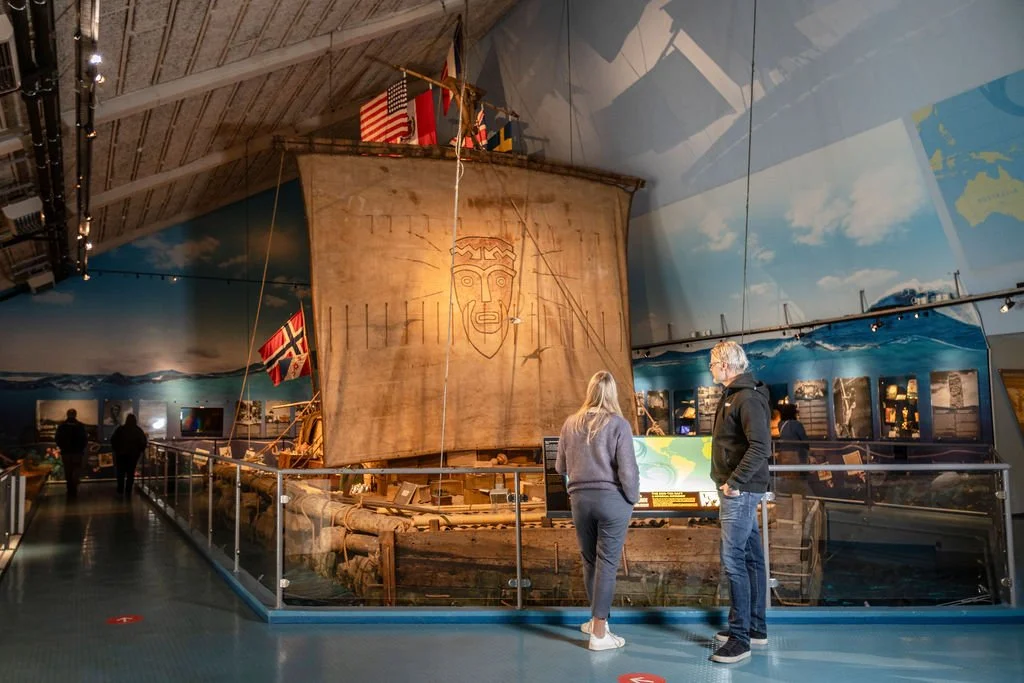
This museum on the Bygdøy peninsula houses the original vessels from Thor Heyerdahl's world-famous expeditions to prove ancient peoples could have crossed oceans on primitive craft. In 1947, Heyerdahl and five others sailed a balsa wood raft (the Kon-Tiki) from Peru to Polynesia across 101 days to prove ancient South Americans could have settled the Pacific Islands. The museum sits right next to the Fram Museum, making them an easy explorer double-feature.
The museum atmosphere is darker and more immersive than typical white-walled galleries, mimicking the feeling of being under Pacific stars or beneath the ocean. The Kon-Tiki raft centerpiece displays the original balsa logs and hemp ropes that held together for 101 days at sea. The Ra II, a vessel made entirely of papyrus reeds, sits nearby. Heyerdahl sailed this across the Atlantic to prove ancient Egyptians could have reached the Americas. The boat is surprisingly large and elegant up close.
The underwater exhibit below the rafts features a "dry" tunnel you walk through with a life-sized model of the massive whale shark that famously swam under the Kon-Tiki during the expedition. The Easter Island (Rapa Nui) collection fills a walk-through "cave" with statues and artifacts (some replicas, some originals) from Heyerdahl's archaeological digs there. He was obsessed with Easter Island theories.
The museum cinema on the lower level screens the Oscar-winning 1950 documentary (filmed by the crew on the raft) daily at 12pm. This gives crucial context to the vessels you're looking at. Logbook excerpts displayed throughout detail terrifying storms and shark encounters in the crew's own words.
Combine with Fram Museum next door using a combo ticket for a 2-3 hour explorer-focused visit to Bygdøy. Arrive via the Bygdøy ferry if weather permits for the scenic fjord approach.
Highlights
Best time to go
Time needed
Getting there
What to do nearby


Hotels nearby