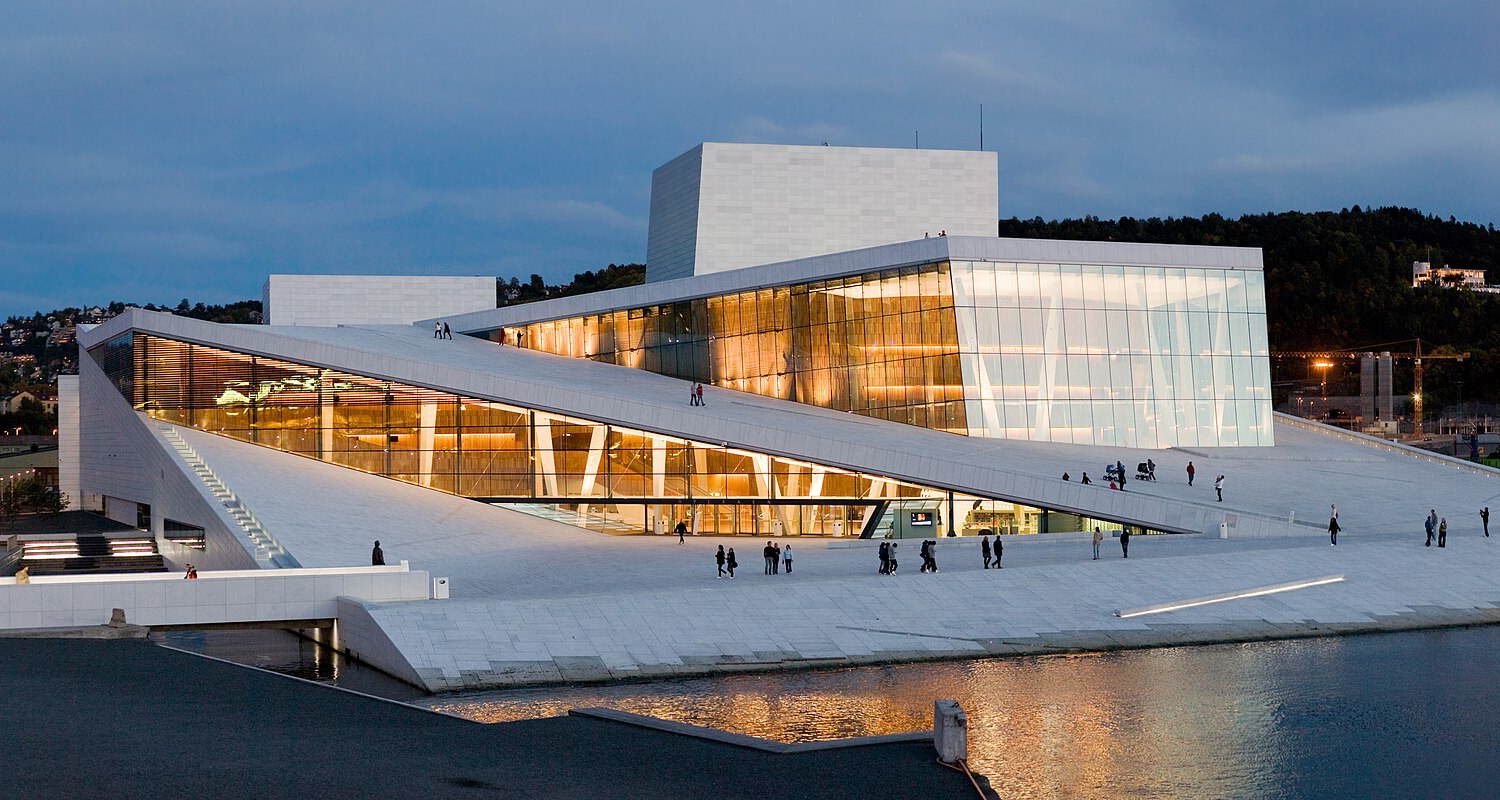
The Opera House is a five-minute walk from Oslo Central Station, and it just might be the best first stop in the city. The roof walk costs nothing, it takes half an hour, and the views from the top give you a mental map of Oslo before you've done anything else.
Walk the Roof
Snøhetta designed the building so the roof slopes from the water's edge up to a broad viewing platform. You walk up white Carrara marble and Norwegian granite, open to everyone, all day.
From the top you get Akershus Fortress to the west, the fjord islands straight ahead, and the MUNCH museum right next door. Walk counterclockwise and stop at the higher corner to line up the fortress against the water. That's the photo.
The marble gets dangerously slippery when wet or icy. In winter, sections of the roof are roped off entirely. Wear shoes with grip any time of year, and if it's been raining, take it slow on the steeper sections.
Inside the Foyer
The outside is all white stone and glass. Inside, it's oak everywhere. The "Wave Wall," a massive curving structure of golden oak strips, wraps around the main auditorium. It works as acoustic insulation, but mostly you'll notice how warm the whole space feels compared to the roof you just walked down from. The lobby windows run about 15 metres tall with almost no framing, so you're looking straight back out at the fjord.
Worth finding: the Olafur Eliasson wall panel near the roof supports, a perforated surface lit from behind to look like melting ice. It's tucked away and easy to walk past.
You don't need a performance ticket to enter the foyer, browse the shop, or get a coffee. It's open Monday to Saturday from 11:00, Sundays from 12:00.
Seeing a Show
The main auditorium seats about 1,350 in a horseshoe layout, so you're close to the stage from pretty much anywhere. Every seat has a small screen for translated libretti in Norwegian and English alongside the original language.
Backstage tours run in English on Saturdays and Sundays, last about 50 minutes, and sell out fast. Tickets go on sale every Tuesday for that same week, so check the Opera House website on Tuesday morning if you want a spot. There's also a free pre-show lecture one hour before main stage performances, but it's in Norwegian only.
If you have two days in Oslo, come twice: once for the roof during the day, and once in the evening when the oak-lined foyer is lit up behind all that glass. The MUNCH museum is next door, and Deichman Bjørvika, Oslo's main public library, is a two-minute walk. You can fill a solid half-day in Bjørvika.
Highlights
Best time to go
Time needed
Getting there
What to do nearby
Hotels nearby