
By: Chris ⎜ Last updated
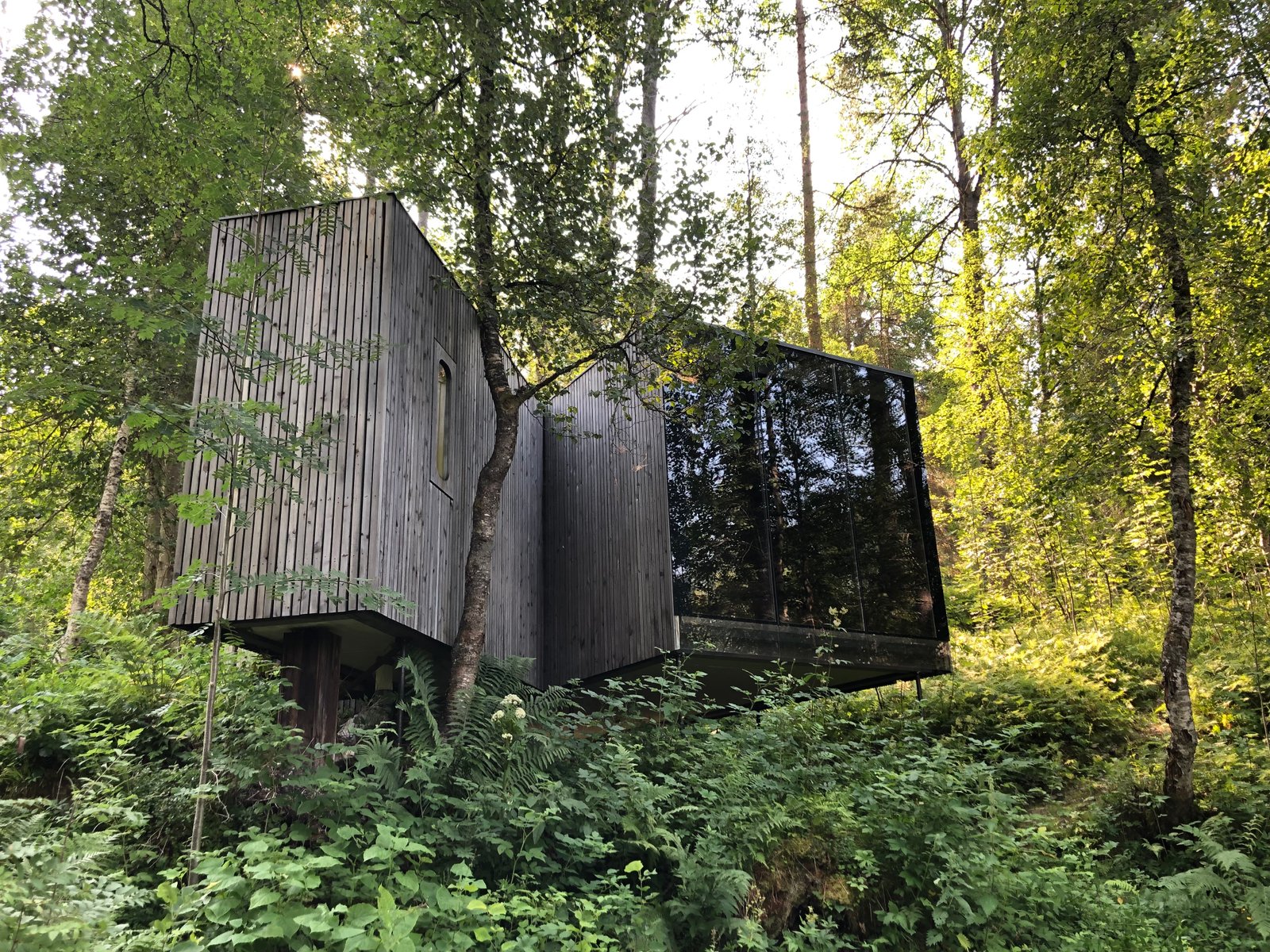
You've probably seen it. The glass box hovering above a Norwegian river, forest pressing against floor-to-ceiling windows, an AI humanoid walking past in a scene from Ex Machina. Or maybe it was Roman Roy complaining that his room was too small in Succession. Either way, the image sticks: nine glass cubes scattered through a birch forest, a river running underneath.
Juvet Landskapshotell opened in 2010 on the Burtigarden farmstead in Valldal, a small village on Norway's northwest coast. The architects, Jensen & Skodvin, were given an impossible brief: build a hotel inside a protected conservation area without blasting rock, pouring concrete foundations, or leaving any permanent trace. Their solution was to drill steel rods directly into the existing rock face and float the cabins above the terrain. The moss, the boulders, the blueberry heather, all of it stays exactly where it was. If the buildings were removed tomorrow, the landscape would show almost no evidence they'd ever existed.
In 2025, the Michelin Guide awarded Juvet a Key, the new distinction recognising hotels that offer something meaningful rather than just thread counts and minibars.
The architecture
The cabins are positioned near the river, each one oriented through millimetre-precise plotting so that no room looks into another. There are no curtains, but the positions of the cabins is such that only the birds will look in. The interiors are deliberately dark, the wooden surfaces treated with transparent oil mixed with black pigment. At night, this eliminates reflections on the glass. Your eye is constantly pulled outward, toward the river and the trees and the shifting weather.
The structures use natural Norwegian timber that weathers over time, slowly camouflaging into the birch and aspen. The steel frames, the slim window profiles, all of it is designed to dissolve the boundary between inside and outside. The architecture functions both as a lens and as shelter.
Who this works for
Juvet is for couples or small groups who define luxury as the absence of distraction. If you want absolute stillness, architectural immersion, and forced disconnection, this is the place. The rooms have no televisions. The wifi works but you're not here to doomscroll Instagram on your phone. You'll spend time watching nature move through the glass.
This is also where Ex Machina and Succession fans come to stand exactly where Oscar Isaac or Alexander Skarsgård stood. The production design team didn't have to do much work; the hotel already looked like a billionaire's reclusive lair.
But the minimalism cuts both ways. There are no curtains; during summer's 20 hours of daylight, the glass walls let all of it in. Bring a sleep mask. There's no room service, no staff hovering. If you have mobility issues, the Bird Houses require climbing a ladder to a lofted bed, and the property involves gravel paths across uneven terrain. This is a premium experience at several thousand NOK per night, and it delivers that value through what it removes rather than what it adds.
The rooms
Ten rooms total, divided into three categories.
The Landscape Rooms are the reason people book a year in advance. Seven standalone cubes on stilts, each with one or two walls of floor-to-ceiling glass. Heated floors, a bed, a chair, a bathroom. No minibar, no desk, no clutter competing with the view. Each room is oriented toward a different piece of landscape: the river, the forest canopy, a particular boulder formation. Rooms 6 and 7 have sofabeds if you're travelling with a child.
The Bird Houses suit travellers who want the Juvet experience at a lower price point and can handle extreme minimalism. Eight square metres. A lofted bed accessed by wall ladder. A handheld shower; for a proper one, you'll walk to the Bath House. Twelve windows of different sizes punch through the walls. The effect is sleeping in a bird's nest cantilevered over the forest.
The Writer's Lodge is something else entirely: a 70-square-metre cabin with two bedrooms, a kitchen, and a living room, surrounded by forest rather than suspended above a river. No floor-to-ceiling glass drama. This is the practical choice for families or groups who need space and can live without the signature architectural experience.
What a day looks like
There's no lunch service. Daily breakfast in the Barn, the restored 18th-century farmhouse that serves as the hotel's communal heart. Fresh bread, local cheeses, cold cuts, cereal, good coffee. The expectation is that you'll make sandwiches and pack a thermos if you're heading out for the day.
The middle of the day is yours. Most guests hike the trails around the property, drive to Trollstigen or Geiranger, or book an activity through one of the local operators. Some just sit in their rooms and watch the river. The Bath House opens at noon: a steam room and an outdoor hot tub set into a riverbank, all behind a 15-metre glass wall facing the water. You book a time slot so you're not sharing it with too many other guests.
Dinner
At 19:30, everyone gathers in the Barn at a long communal table. Fifteen to twenty people, depending on occupancy. The kitchen serves a three-course set menu built around whatever's local and seasonal: rich fish soup, locally sourced beef, desserts made from berries picked that week. You don't choose; you eat what's served. Communicate dietary restrictions when you book.
The communal format breaks down the usual social barriers of luxury travel. By the second night, you'll know the German architects at the end of the table and the American couple who drove up from Bergen.
Wine is served with dinner and charged separately. There's no formal bar, but the staff can make basic cocktails and pour local beer.
Nearby activities
Valldal brands itself as "The Adventure Valley," which sounds like marketing until you see what's on offer.
Canyoning at Gudbrandsjuvet is the standout. The gorge is minutes from the hotel, the same rock formations you can see from some of the rooms. Guided trips take you through via ferrata sections, across rope bridges, down cliff jumps into the Valldøla River, through a zip line, and finish with a swim through white-water rapids. Tours run about four hours and suit anyone reasonably fit; there are also gentler family-friendly options. Several operators work the area, including Uteguiden and Valldal Naturopplevingar.
White-water rafting on the Valldøla covers 11 kilometres of rapids. The river is Class II-III, suitable for beginners but with enough action to be interesting. Family tours stick to the calmer lower section.
Trollstigen is 15 kilometres away. The 11 hairpin bends, the 320-metre waterfall, the cantilevered viewing platforms, all of it is worth seeing. But check the road status before driving. Trollstigen is closed from October to May and can close at short notice for weather.
Geirangerfjord is accessible via ferry from Valldal. The UNESCO World Heritage fjord is one of Norway's most photographed sights for good reason.
The hotel is right on the Geiranger-Trollstigen scenic route.
When to go
Juvet is open from late February through the end of November. December, January, and the first half of February are closed.
Summer means endless daylight, green forests, the river at full flow, and strawberry season in Valldal. This is peak demand; expect to book a year in advance.
Spring and autumn offer moodier conditions: fog rolling through the valley, rain hitting the glass walls, colours shifting from greens to golds. Fewer guests, easier bookings, and a more atmospheric experience if moody weather appeals to you. The trade-off is that some activities shut down, Trollstigen closes, and the weather becomes less predictable.
Late winter (February-March) is for ski touring and a completely different landscape: snow-covered terrain, frozen river edges, short days. This is the quiet season.
Getting there
Juvet sits directly on the Geiranger-Trollstigen scenic route, one of Norway's 18 National Tourist Roads. The easiest approach is from Ålesund.
From Ålesund Airport (AES): 100 kilometres, about 90 minutes by car. Rent at the airport. This gives you the flexibility to explore on your own schedule, which matters in a region where public transport is sparse. The drive follows the fjord and passes through Valldal before climbing toward the hotel.
From Åndalsnes via Trollstigen: 40 kilometres, about 45 minutes when the road is open (typically mid-May to late October). This is the dramatic approach, descending the 11 hairpins with the Stigfossen waterfall beside you. When Trollstigen is closed, the detour via Sjøholt adds about an hour.
From Oslo: Seven to eight hours drive depending on your route. The Trollstigen approach takes you through Dombås and Åndalsnes. The Geiranger route goes through Otta and includes the Eidsdal-Linge car ferry, a 10-minute crossing that runs frequently and doesn't require booking. Both routes are worth doing as road trips in their own right if you have the time.
Public transport: Impractical outside summer. From mid-June to mid-August, regional buses run from Åndalsnes toward Geiranger; you can get off at the Gudbrandsjuvet stop near the hotel. Outside that window, don't try it.
Book early
Juvet books out. The Succession effect accelerated demand that was already strong; the best rooms now fill a year in advance for summer dates. If you're planning a trip six months out and the calendar shows nothing available, that's normal.
Weekend stays require booking the full weekend, Friday through Sunday. The Writer's Lodge requires a minimum of two nights regardless of when you stay.